
Shodh Sari-An International Multidisciplinary Journal
Vol-05, Issue-03 (Jul-Sep 2026)
An International scholarly/ academic journal, peer-reviewed/ refereed journal, ISSN : 2959-1376
Influence of Socioeconomic Status on Mental Health: The Mediating Role of Resilience
Ibrahim, Abdulqudus Olansile1 and Afolabi, Abimbola2
1&2Department of Social Work, Faculty of Education, University of Ibadan, Nigeria
ORCiD: 20000-0001-8313-9902
Abstract
Socioeconomic status (SES) is a strong and enduring predictor of mental health outcomes in all societies. People living in poverty are vastly more likely to be subjected to chronic stressors including financial insecurity, unemployment, lack of educational opportunities and barriers to receiving adequate health care. These systemic disadvantages greatly increase the risk for depression, anxiety, and poor mental health. Yet, mental health problems do not inevitably result from socioeconomic adversity, indicating the presence of protective processes within adverse environments. This article promotes the view that mental resilience is an important mediating process in the relation between SES and mental health. Although structural inequalities determine who is exposed to stress, resilience shapes how like individuals make sense of, react to, and bounce back from adversity. Resilience is not viewed as a fixed trait, but rather as a fluid and attainable quality that can be nurtured through positive relationships, engagement in adaptive coping mechanisms, connection to community, and availability of opportunities. Identifying resilience as a mediator transforms the discussion from a deficit-based model of thinking to a strength-based perspective. It recognises that socioeconomic change is necessary for mental health equity in the long term, but that resilience-focused interventions can help to reduce psychological distress in the meantime. Schools, families, workplaces, and community organizations are instrumental in developing contexts that foster adaptive coping and emotional regulation. Hence, the response to mental health inequalities has to be two-pronged: one that focusses on the structural policies that reduces socioeconomic inequalities and other that focusses on psychosocial interventions that enhances resilience. To that end, implementation of resilience-promoting programmes in low-SES populations provides a practical and morally defensible means of addressing mental health vulnerability as a part of larger system-of-care reform.
Keywords: Socioeconomic status, Mental health, psychological resilience, social inequality, Depression
About the Authors
Abdulqudus Olansile Ibrahim is a researcher based in the Department of Social Work within the Faculty of Education at the University of Ibadan, Nigeria. His academic work primarily centers on clinical social work, social inequalities, and the structural determinants of community mental health. His research aims to identify actionable pathways and systemic interventions that support marginalized individuals navigating socioeconomic disadvantages.
Abimbola Afolabi is a scholar and researcher also affiliated with the Department of Social Work, Faculty of Education at the University of Ibadan, Nigeria. Specializing in psychosocial wellbeing and public health social work, her academic contributions focus on identifying protective behavioral assets—such as psychological resilience and social support networks—that buffer vulnerable populations against chronic environmental stressors.
Together, the authors combine their expertise in social work and behavioral sciences to explore the intricate relationships between structural socioeconomic stratification, adaptive coping mechanism dynamics, and public mental health outcomes in contemporary societies.
Impact Statement
This article provides a critical conceptual and theoretical examination of how socioeconomic status (SES) acts as an enduring structural predictor of mental health outcomes and evaluates the crucial mediating role played by mental resilience. By exploring how systemic disadvantages—such as chronic financial insecurity, unemployment, and systemic educational barriers—heighten vulnerability to depression and anxiety, the research transitions the clinical discourse from a deficit-based framework to a strength-based perspective. Synthesizing foundational psychological models with structural inequalities, the study frameworks resilience not as an innate, fixed trait, but as a fluid, dynamic process nurtured through adaptive coping, supportive relational networks, and institutional opportunities. Ultimately, it delivers a strategic actionable roadmap for clinical psychologists, social workers, and mental health policymakers aiming to construct community-centered, resource-rich intervention systems in socioeconomically marginalized landscapes.
Cite This Article
APA Style (7th Edition): Ibrahim, A. O., & Afolabi, A. (2026). Influence of socioeconomic status on mental health: The mediating role of resilience. Shodh Sari: An International Multidisciplinary Journal, 5(3), 215–233. https://doi.org/10.59231/SARI7953
MLA Style (9th Edition): Ibrahim, Abdulqudus Olansile, and Abimbola Afolabi. “Influence of Socioeconomic Status on Mental Health: The Mediating Role of Resilience.” Shodh Sari: An International Multidisciplinary Journal, vol. 05, no. 03, 2026, pp. 215–233, doi:https://doi.org/10.59231/SARI7953.
Chicago Manual of Style (17th Edition): Ibrahim, Abdulqudus Olansile, and Abimbola Afolabi. 2026. “Influence of Socioeconomic Status on Mental Health: The Mediating Role of Resilience.” Shodh Sari: An International Multidisciplinary Journal 5, no. 3 (July): 215–233. https://doi.org/10.59231/SARI7953.
Page Numbers: 215–233
DOI: https://doi.org/10.59231/SARI7953
Subject: Education, Social Work, Mental Health Psychology, and Socio-Economic Systems.
Received: Apr 15, 2026
Accepted: May 19, 2026
Published: Jul 01, 2026
Thematic Classification: Socioeconomic Status (SES), Mental Health Outcomes, Psychological Resilience, Chronic Stressors, Adaptive Coping Mechanisms, Depression & Anxiety, Strength-Based Perspective, Social Stratification, Mental Health Interventions, Community Resource Governance.
Introduction
Mental health remains unevenly distributed across populations, with individuals from lower socioeconomic backgrounds experiencing higher rates of psychological distress, depression, anxiety, and diminished well-being. These inequalities extend across age groups, with youth and adolescents from disadvantaged families exhibit rapid and higher vulnerability to mental health challenges. This situation may persist into adulthood if unaddressed. The uneven distribution of mental health outcomes reflects not only individual differences but also structural and contextual factors embedded within society, including access to resources, social capital, and public health services (Albert, 2025). As social workers and policy makers, having an understanding of the mechanisms that link socioeconomic status (SES) to mental health is essential for the development of effective interventions that mitigate these disparities and promote well-being.
Socioeconomic status functions as one of the major structural determinants of mental health. These include multiple dimensions such as income, educational attainment, occupational status, and material resources Mossakowski, (2025). Individuals in lower SES brackets often encounter chronic stressors, including financial insecurity, unstable housing, and limited access to quality healthcare, all of which increase susceptibility to mental health problems. Moreover, societal inequalities amplify these effects, as disparities in public health infrastructure and social services influence the availability and quality of mental health support (Albert, 2025). SES therefore indicates both direct and indirect effects on mental health, shaping exposure to risk factors while simultaneously constraining access to protective resources. Research found that these effects accumulate over time, create a cycle of disadvantage that compounds psychological vulnerability (Guo & Li, 2025).
Traditional explanations of mental health inequalities have often emphasized deficits, pathology, and individual-level risk factors. These deficit-based frameworks attribute psychological problems primarily to biological or personal weaknesses, such as genetic predisposition or maladaptive coping strategies (Williams et al., 2017). Although such models present an understanding of the clinical manifestations, they inadequately account for the broader structural determinants of mental health and the capacity for adaptation and recovery (McAllister et al. 2018). Focusing narrowly on deficits risks reinforce stigma and overlook the resources and competencies individuals draw upon to maintain well-being under adverse circumstances (Heinz et al., 2025). The limitations of pathology-focused explanations necessitate a shift toward frameworks that integrate structural determinants with strength-based processes that emphasize the dynamic relationship between risk and protective factors.
Resilience is observed as a core strength-based process that can mediate the effects of socioeconomic disadvantage on mental health. Defined as the ability to maintain or regain psychological well-being in the face of adversity, resilience includes individual capacities, social support networks, and systemic resources (Heinz et al. 2025; Gao et al. 2017). Evidence indicates that resilience operates across multiple levels: at the individual level, it manifests through adaptive coping strategies, optimism, and self-efficacy; at the social level, supportive relationships buffer stress and facilitate access to opportunities; at the systemic level, community resources and policies strengthen the capacity to withstand adversity (Guo & Li, 2025). However, the mediating role of resilience suggests that mental health outcomes among individuals with low SES are not predetermined but can be positively influenced by interventions that cultivate adaptive capacities and social supports.
According to Guo and Li (2025), perceived family SES is indirectly associated with subjective well-being through social support and resilience. This emphasizes the interdependence of structural and personal resources. In addition, resilience promotes general well-being, which in turn enhances mental health outcomes. It suggests that interventions targeted at building resilience can interrupt the pathways that links socioeconomic adversity to psychological distress (Gao et al., 2017). These findings stressed the potential for resilience-focused strategies to address mental health inequalities while moving beyond deficit-oriented approaches.
The present study aims to examine the influence of socioeconomic status on mental health, with a focus on the mediating role of resilience. Specifically, the study seeks to address how socioeconomic status affect mental health outcomes among individuals across different age and social groups, socio-economic status and residence approach and the extent to which resilience mediate the relationship between SES and mental health. However, the significance of this research extends to policy, social work practice, and intervention design. The identification of the mediating role of resilience provides guidance for mental health interventions that not only alleviate symptoms but also strengthen adaptive capacities, especially among populations exposed to socioeconomic disadvantage. Social work practitioners can adapt resilience related approaches or strategies to develop programs that enhance coping skills, build social support networks, and facilitate access to community resources. This will help promote equity in mental health outcomes. At the policy level, findings may inform strategies that address structural determinants of mental health, including income support, educational opportunities, and equitable distribution of mental health services
Theoretical Framework Resilience Theory
Resilience theory examines the capacity of individuals, groups, and communities to adapt, recover, or thrive when confronted with adversity. It originates from research in psychology, social work, and public health, and has evolved to incorporate dynamic, context-sensitive processes rather than static personality traits (Van Breda, 2001). The core assumption of resilience theory is that vulnerability and strength coexist, and protective resources can buffer against adverse outcomes. Adversity alone does not determine mental health trajectories; rather, the interplay of risk and protective factors shapes individual outcomes (Carlson et al., 2011).
Resilience is dynamic and context-dependent that reflects the notion that capacities to cope with stressors vary across time, situations, and environmental conditions (Tseliou & Ashfield-Watt, 2022). It is influenced by individual characteristics such as problem-solving ability, optimism, and self-efficacy, as well as relational and structural factors including family support, peer networks, community cohesion, and institutional policies (Diržytė, Rakauskienė, Servetkienė, 2017). The theory posits that these protective factors do not operate in isolation; rather, their interaction determines the degree to which individuals withstand stress, adapt to challenges, and maintain psychological well-being (Van Breda, 2018).
Resilience theory emphasizes that protective factors exist at multiple levels. Individual resources include cognitive and emotional competencies, which enable adaptive coping under stressful conditions (Van Breda, 2001). Relational resources derive from social support networks, encompassing family, friends, and mentors who provide emotional, instrumental, and informational support (Tseliou & Ashfield-Watt, 2022). Structural or systemic resources involve formal and informal institutions, community programs, and policies that facilitate access to education, healthcare, and employment opportunities (Diržytė, Rakauskienė, Servetkienė, 2017). The presence or absence of these resources shapes how individuals respond to socioeconomic adversity, suggesting that resilience is malleable and can be strengthened through targeted interventions.
The application of resilience theory to mental health research has expanded, especially in contexts of low socioeconomic status (SES). Socioeconomic disadvantage often exposes individuals to chronic stressors, including financial instability, social exclusion, and limited access to healthcare, which increase susceptibility to mental health problems (Salem & Robenson, 2025). Resilience theory therefore, provides a framework to understand how protective factors mitigate these risks. This explains that individuals facing structural challenges can achieve positive mental health outcomes when sufficient individual, relational, and structural resources exist (Heinz et al., 2025). The theory moves beyond deficit-oriented models that attribute psychological difficulties solely to vulnerability by framing resilience theory. This provides a strength-based understanding of mental health in disadvantaged populations (Van Breda, 2018).
Resilience is also considered developable. Interventions can promote adaptive capacities through skill-building, psychosocial support, and systemic changes that improve access to resources (Van Breda, 2001). In low-SES settings, this perspective shifts attention from solely mitigating risks to cultivating strengths that enable individuals and communities to thrive despite adversity. Evidence indicates that enhancing resilience at individual, relational, and structural levels can improve mental health outcomes and reduce the long-term effects of socioeconomic disadvantage (Gao et al., 2017; Tseliou & Ashfield-Watt, 2022).
Resilience as a Mediating Mechanism
Resilience functions as a mediating mechanism when it intervenes between an independent variable, such as socioeconomic status, and an outcome variable, such as mental health. Unlike moderation, which affects the strength or direction of a relationship, mediation explains the process through which one variable influence another. Conceptually, resilience mediates the relationship between SES and mental health by converting structural disadvantages into potential for adaptive responses. Individuals with low SES may face increased exposure to stressors, but resilience provides pathways to maintain psychological balance to strengthen well-being Resilience, comprising individual competencies, social support, and systemic resources, transforms these stressors into challenges that can be managed effectively (Van Breda, 2001; Heinz et al., 2025). The degree of resilience influences mental health outcomes, such that stronger resilience is associated with lower levels of psychological distress and higher levels of well-being.
Applying a strength-based approach to resilience reframes the analysis of mental health inequalities from a focus on deficits to an understanding of capacity, resources, and potential for growth (Carlson et al., 2011). Interventions can target multiple levels: improving individual skills, strengthening family and community support networks, and promoting policies that increase access to protective resources. This approach ensures that interventions do not merely reduce vulnerability but actively enhance the ability of individuals to adapt and maintain well-being in challenging environments (Diržytė, Rakauskienė & Servetkienė, 2017). The perspective will further inform policy design and program development, emphasize resource allocation, psychosocial support, and the cultivation of adaptive capacities.
Fig 1: Conceptual Model of the Mediating Role of Resilience in the Relationship Between Socioeconomic Status and Mental Health
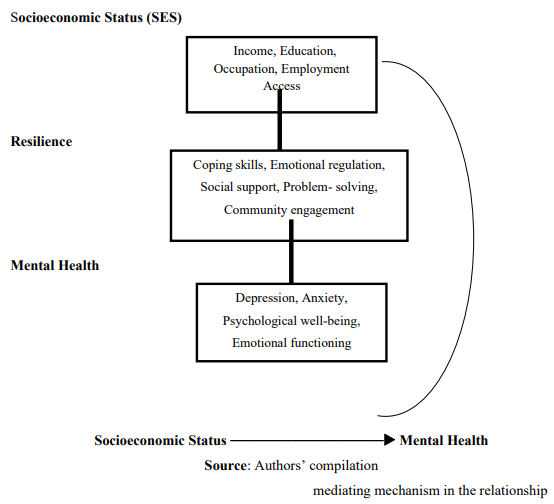
Conceptual model illustrating resilience as a mediating mechanism in the relationship between socioeconomic status and mental health outcomes.
Empirical Review
Socioeconomic Status and Mental Health
Socioeconomic status has a profound influence on mental health, with individuals experience poverty or economic disadvantage facing higher risks of depression, anxiety, and other psychological disorders. Empirical research demonstrates that low SES is associated with both elevated stress exposure and constrained access to protective resources, which result in an increased prevalence of mental health problems (Kim & Cho, 2020). Across diverse populations, studies have shown that material deprivation, financial insecurity, and social inequality contribute to psychological distress and impair overall well-being (Afolabi, 2024; Businelle et al., 2014).
Stressful life events emerge as a key mechanism that links socioeconomic disadvantage to mental health outcomes. Individuals with lower SES are more likely to encounter economic shocks, job instability, family conflict, and unsafe living conditions. These stressors accumulate over time and create a chronic burden that compromises emotional and cognitive functioning. Businelle et al., (2014) found that exposure to stressful events mediated the relationship between SES and mental health, indicating that lower-income individuals experience more frequent and severe stressors, which in turn increase vulnerability to depression and anxiety. In addition, Kim and Cho, (2020) observed that work-life conflicts associated with low occupational status intensified stress and negatively affected mental health outcomes.
Material deprivation also contributes to the SES-mental health link by limiting access to essential resources that support psychological well-being. Individuals with constrained financial means often face barriers to healthcare, nutritious food, safe housing, and educational opportunities. These deficits increases both physiological and psychological vulnerabilities. Kivimäki et al., (2020) demonstrated that socioeconomic disadvantage during adulthood was associated with higher incidence of mental and physical health conditions across multiple cohorts. The study indicated that limited resources not only increase exposure to stress but also reduce the capacity to adopt preventive health behaviors that may amplify mental health disparities over time.
Access to mental health services represents another critical factor connecting SES and psychological outcomes. Individuals from lower socioeconomic backgrounds often encounter structural obstacles, including financial barriers, lack of insurance, and limited availability of psychotherapy or counseling services. Niemeyer and Knaevelsrud, (2023) found that lower SES was associated with reduced access to psychotherapy, with socioeconomic inequalities resulted in delayed treatment and poorer clinical outcomes. More so, Afolabi, Odedokun and Fatoye (2024), reveal that emotional distress is significantly predicted by conditions of deprivation, institutional confinement, and limited access to psychosocial resources.
In Nigeria, Agberotimi, Akinsola, Oguntayo, Olaseni, (2020) examined mental health outcomes during the COVID-19 pandemic and found that individuals with lower socioeconomic status experienced higher levels of anxiety and depression compared with higher-SES groups. Limited financial resources, inadequate social support, and restricted access to mental health services amplified the negative impact of pandemic-related stressors. In addition, a study on lockdown experiences by Afolabi (2020) shows that economic disruption, income insecurity, and restricted mobility during the COVID-19 pandemic were linked to an increased state of anxiety, fear, and psychological distress among adults. These findings explain how sudden socioeconomic shocks intensify mental health vulnerability among individuals with limited economic buffers.
Socioeconomic Status and Resilience Development
Socioeconomic status influences the development and maintenance of resilience as it determines access to protective resources and opportunities that enhance adaptive capacity. Individuals from higher SES backgrounds generally benefit from greater material, social, and educational resources, which enhance their ability to respond effectively to adversity. Whereas, low-SES populations face limitations that constrain resilience (Vyas & Dillahunt, 2017; Prabhu, Shekhar, 2017). These constraints create unequal capacity to manage stressors and sustain psychological well-being across socioeconomic groups.
Access to formal education provides individuals with cognitive tools, problem-solving skills, and health literacy that facilitate adaptive responses to challenges. Reyes, Satorres, Melendez, (2020) found that older adults with higher educational attainment exhibited greater resilience, which translated into improved life satisfaction and psychological well-being. Education also mediates exposure to stressors by expanding employment opportunities and financial stability (Tseliou, Ashfield-Watt, 2022). Social capital constitutes another critical pathway through which SES impacts resilience. Individuals embedded in supportive networks of family, friends, and community organizations can draw on emotional, informational, and instrumental resources that protect them against stress and adversity. Vyas & Dillahunt, (2017) emphasized that low-SES communities face weakened social cohesion and limited access to formal support systems, restricting their capacity to mobilize protective resources.
Community resources and structural support systems further shape resilience in relation to SES. Access to healthcare, mental health services, safe housing, and recreational spaces contributes to both psychological and physical well-being. Niemeyer, Knaevelsrud, 2023 and Tseliou, Ashfield-Watt, (2022) demonstrate that availability of institutional resources strengthens individuals’ ability to maintain resilience under stress. In low-SES settings, scarcity of these resources amplifies vulnerability. Empirical research also indicates that SES interacts with resilience to influence responses to societal crises. Wilder, Lauderdale and Hawkley, (2023) found that older adults with higher SES reported greater capacity to find positive meaning in the COVID-19 pandemic. This demonstrates that material and social resources enhance adaptive psychological strategies. In a similar view, Schäfer et al., (2024) reported that individual, social, and societal resilience factors operate in conjunction with socioeconomic conditions to determine responses to challenges. This emphasizes the multilevel nature of protective resources.
Furthermore, studies from different populations illustrate that interventions aimed at strengthening resilience must account for socioeconomic inequalities. Low-SES communities may require strategies targeted to promote social networks, educational opportunities, and access to services that enhance adaptive capacities (Vyas & Dillahunt, 2017; Prabhu & Shekhar, 2017). Building resilience under constrained conditions relies on using existing community strengths and creating structural supports that reduce barriers. Conceptually, resilience functions as both an outcome and a process, with socioeconomic conditions determining the extent to which individuals can develop and apply adaptive capacities in response to adversity (Yildirim et al., 2022; Joshi & Galvin, 2022).
Resilience and Mental Health Outcomes
Empirical research across disciplines confirms that resilience is significant in shaping mental health outcomes among individuals exposed to stress, adversity, and social disruption. Evidence from population-based, clinical, and community studies shows that resilience associates with lower psychological distress and improved mental well-being across age groups and settings (Tseliou & Ashfield-Watt, 2022). Individuals who report stronger emotional control, perceived competence, and adaptive capacity experience fewer symptoms of anxiety and depression. These associations remain evident after adjustment for contextual factors, which suggests that resilience functions as an active psychological resource rather than a background characteristic (Tseliou & Ashfield-Watt, 2022).
Studies conducted in African settings show how resilience moderates the negative mental health effects of bullying and social stress. Adolescents with higher resilience report better emotional well-being, despite exposure to peer victimization and social pressure (Chukwuemeka, 2025). Similar findings emerge from school-based research, where resilience associates with improved psychological outcomes among students exposed to bullying and academic stress (Moore, 2017). Likewise, Afolabi and Animashaun (2024), show that bullying significantly impairs adolescents’ psychological wellbeing, especially where protective and resilience-enhancing supports are weak. The findings revealed that resilience-related factors such as supportive peer relationships and emotionally safe school environments play a critical role in suppressing the mental health consequences of psychosocial stressors. Research also demonstrates that resilience operates through mediating pathways. Studies among Nigerian adolescents show that psychological resilience reduces the impact of early childhood adversity on depressive symptoms. Adolescents with higher resilience experience fewer depressive outcomes even when exposed to early life stress, which confirms its role as a buffering mechanism between adversity and mental health (Ibigbami, 2024). Related work indicates that resilience and self-esteem jointly influence mental health outcomes among adolescents with physical or social challenges (Ibigbami, 2023).
A meta-analytic review reports an inverse relationship between resilience and psychological distress across diverse populations. Higher resilience associates with reduced depression, anxiety, and stress symptoms (Gheshlagh, 2017). These findings strengthen confidence in resilience as a robust mental health factor rather than a context-specific phenomenon. In addition, in research among individuals living with cancer, resilience supports emotional regulation and coping capacity, which contributes to better mental health outcomes during illness and treatment (Macía, 2021). This finding supports the view that resilience remains relevant even under conditions of prolonged physical and emotional strain. Furthermore, studies conducted during the COVID-19 pandemic show that individuals with higher resilience experience fewer affective symptoms and better emotional adjustment during periods of uncertainty and disruption (Verdolini, et al 2021). These outcomes reflect the capacity of resilience to support psychological stability during large-scale societal stress. A multisystemic perspectives further explain these patterns, as resilience emerges through interaction between individuals, families, communities, and institutions. Mental health outcomes improve when personal adaptive capacity aligns with supportive social environments and accessible resources (Ungar, 2020).
Implications for Policy, Practice, Social Work and Mental Health Services
Policy Implications: Mental health outcomes remain closely tied to socioeconomic conditions, which places responsibility on policy systems rather than individuals alone. Poverty reduction and social protection policies serve as indirect mental health interventions because income insecurity, unstable housing, and limited access to basic services increase exposure to psychological stress. Social welfare schemes that provide income support, employment protection, and access to education reduce chronic stressors that undermine mental well-being. Mental health policy therefore requires integration into broader social and economic planning rather than treatment-oriented isolation. When mental health considerations inform housing policy, labour policy, education policy, and social protection, governments address root conditions that shape psychological vulnerability. Such integration supports equity in mental health outcomes and reduces reliance on crisis-based clinical responses.
Practice and Intervention Implications
Intervention approaches benefit from a shift away from deficit-focused models toward resilience-promoting programmes within schools and communities. Educational settings provide opportunities to strengthen emotional regulation, problem-solving skills, and social connection among children and adolescents, especially those from disadvantaged backgrounds. Community-based programmes that promote peer support, mentorship, and collective problem-solving also support mental well-being by strengthening protective resources. Strength-based approaches within mental health and social work practice recognise existing capacities rather than framing individuals as passive recipients of care. Practitioners who build on personal strengths, family support, and community resources create interventions that feel relevant, respectful, and sustainable across different social contexts.
Implications for Social Work and Mental Health Services
Social work and mental health services require a stronger emphasis on prevention and early intervention rather than late-stage treatment alone. Early identification of psychosocial stressors allows services to reduce long-term psychological harm before distress becomes entrenched. Community-based practice remains central to this effort, as local networks serve as first points of support during hardship. Culturally responsive practice ensures that interventions align with lived experiences, values, and social realities of service users. Mental health services that collaborate with community organisations, schools, and social welfare agencies strengthen access and trust and reduce barriers to care. This approach positions social work as a bridge between structural policy action and individual mental health support.
Conclusion
This paper has argued that socioeconomic status shapes mental health outcomes through both structural exposure to disadvantage and unequal access to psychosocial resources. Economic insecurity, limited educational opportunity, and restricted access to care create conditions that increase psychological distress across the life course. At the same time, empirical evidence shows that resilience influences how individuals respond to such conditions. Mental health outcomes do not arise solely from personal vulnerability or biological predisposition; they reflect interaction between social structure and adaptive capacity. This position reframes mental health inequality as a shared social responsibility rather than an individual failure. Resilience emerges as a complementary process rather than a substitute for structural reform. Structural change is still essential because resilience cannot compensate for persistent poverty, social exclusion, or policy neglect. Income support, social protection, and equitable access to education and health services reduce exposure to chronic stressors that undermine mental well-being. Within this, resilience supports psychological stability by strengthening emotional regulation, coping capacity, and recovery after adversity. When resilience receives attention alongside structural reform, mental health policy avoids the risk of placing responsibility solely on individuals while still recognising human agency and adaptive potential. However, the ethical basis for resilience-based interventions rests on principles of dignity, justice, and empowerment. Strength-based approaches respect service users as capable actors with existing resources rather than passive recipients of care. Such approaches align with ethical social work practice because they avoid blame and reduce stigma while supporting autonomy. Resilience-focused interventions also meet ethical standards of fairness when they operate within systems that address structural disadvantage. This study contributes to mental health equity discourse by bridging structural analysis with psychosocial understanding. It advances a balanced perspective that recognises both the social origins of mental distress and the processes that support adaptation under constraint. It also strengthens the case for integrated responses that combine policy reform, community action, and professional practice. Therefore, mental health equity depends on sustained commitment to structural change and ethical investment in resilience. When social policy addresses poverty and exclusion, and practice strengthens adaptive capacity through respectful and culturally responsive approaches, mental health outcomes improve across populations.
Statements & Declarations
Peer-Review Method: This article underwent a double-blind peer-review process involving external experts in the fields of Psychiatric Social Work, Clinical Mental Health, and Socio-Economic Policy Systems.
Competing Interests: The authors Abdulqudus Olansile Ibrahim and Abimbola Afolabi declare that they have no competing interests, financial, personal, or institutional, that could have inappropriately influenced or biased the research design, conceptual frameworks, or conclusions presented in this article.
Funding: This research received no external funding, corporate grants, or financial aid packages from any commercial, private, or non-profit sectors.
Data Availability: The conceptual paradigms, theoretical mediation models, and synthesized multidisciplinary literature matrices analyzed in this study are available within the sections of the article. Any additional literature compilation details are available from the corresponding author on reasonable request.
Licence: Influence of Socioeconomic Status on Mental Health: The Mediating Role of Resilience © 2026 by Abdulqudus Olansile Ibrahim and Abimbola Afolabi is licensed under CC BY-NC-ND 4.0. This work is published by ICERT.
Ethics Approval: This study adopts a conceptual and theoretical methodology drawing exclusively from public scholarly literature, institutional policy whitepapers, and international public health databases. It complied with standard academic ethics and research guidelines of the Department of Social Work, Faculty of Education, University of Ibadan, Ibadan, Nigeria.
Authors’ Contributions: Abdulqudus Olansile Ibrahim and Abimbola Afolabi were collectively responsible for the conceptualization of the research framework, drafting the theoretical mediation design, executing the systemic synthesis of literature on socioeconomic barriers, detailing the dynamic components of mental resilience, constructing the strength-based psychological intervention models, and drafting, editing, and compiling the final manuscript.
References
Afolabi, A. (2020). Mental health implications of lockdown during coronavirus pandemic among adults resident in Ibadan, Nigeria. African Journal of Social Work, 10(3), 50–58.
Afolabi, A. (2024). Psychological stress and mental disorders among students. International Journal of Education Framework, 4(1).
Afolabi, A., & Animashaun, O. F. (2024). Effects of bullying on the psychological and mental wellbeing of adolescents in selected secondary schools in Ibadan, Nigeria. African Journal for the Psychological Studies of Social Issues, 27(2).
Afolabi, A., Odedokun, S. A., & Fatoye, H. A. (2024). Predictors of emotional distress among inmates of Agodi Correctional Centre, Ibadan, Nigeria. International Journal of Innovation and Applied Studies, 43(2), 304–314.
Agberotimi, S. F., Akinsola, O. S., Oguntayo, R., & Olaseni, A. O. (2020). Interactions between socioeconomic status and mental health outcomes in the Nigerian context amid COVID-19 pandemic: A comparative study. Frontiers in Psychology, 11, Article 559819. https://doi.org/10.3389/fpsyg.2020.559819
Albert, M. (2025). Mental health disparities across regions: Exploring the roles of inequality, socioeconomic factors and regional public health service. Regional Science Policy & Practice, Article 100265. https://doi.org/10.1111/rsp3.100265
Businelle, M. S., Mills, B. A., Chartier, K. G., Kendzor, D. E., Reingle, J. M., & Shuval, K. (2014). Do stressful events account for the link between socioeconomic status and mental health? Journal of Public Health, 36(2), 205–212. https://doi.org/10.1093/pubmed/fdt051
Carlson, J. L., Haffenden, R. A., Bassett, G. W., Buehring, W. A., Collins, M. J., III, Folga, S. M., Petit, F. D., Phillips, J. A., Verner, D. R., & Whitfield, R. G. (2011). Resilience: Theory and application. Argonne National Laboratory (ANL).
Chukwuemeka, N. A., Ayogu, C. K., & Obioha, W. C. (2025). Bullying and mental well-being among adolescents in sub-Saharan Africa: Moderating role of resilience. Journal of Mental Health and Human Behaviour, 30(2), 98–104.
Diržytė, A., Rakauskienė, O. G., & Servetkienė, V. (2017). Evaluation of resilience impact on socio-economic inequality. Entrepreneurship and Sustainability Issues, 4(4). https://doi.org/10.9770/jesi.2017.4.4
Gao, T., Ding, X., Chai, J., Zhang, Z., Zhang, H., Kong, Y., & Mei, S. (2017). The influence of resilience on mental health: The role of general well‐being. International Journal of Nursing Practice, 23(3), Article e12535. https://doi.org/10.1111/ijn.12535
Gheshlagh, R. G., Sayehmiri, K., Ebadi, A., Dalvandi, A., Dalvand, S., Maddah, S. B., & Tabrizi, K. N. (2017). The relationship between mental health and resilience: A systematic review and meta-analysis. Iranian Red Crescent Medical Journal, 19(6), Article e12535. https://doi.org/10.5812/ircmj.41444
Guo, C., & Li, X. (2025). Perceived family socioeconomic status and subjective well-being in Chinese youth and adolescents: The mediating roles of social support and resilience. Child Indicators Research, 18(5), 1957–1972. https://doi.org/10.1007/s12187-024-10115-3
Heinz, S. S., O’Brien, A. J., Walker, C., O’Sullivan, M., Rouse, P., Whitehead, J., Parsons, M., Cunningham, R., & Edmonds, M. (2025). Mediating pathways between resilience, mental health and wellbeing: A scoping review of individual, social, and systemic factors. BMC Public Health, 25(1), Article 375. https://doi.org/10.1186/s12889-025-21215-6
Ibigbami, O. I., Folayan, M. O., Oginni, O. A., & Lusher, J. (2024). Mediating effects of psychological resilience and self-esteem on the association between early childhood adversity and depressive symptoms among adolescents in Nigeria. Adversity and Resilience Science, 5(3), 257–266. https://doi.org/10.1007/s42844-024-00132-1
Ibigbami, O. I., Folayan, M. O., Oginni, O., Lusher, J., & Sam-Agudu, N. A. (2023). Moderating effects of resilience and self-esteem on associations between oral health problems and mental health among adolescents. PLoS One, 18(5), Article e0285521. https://doi.org/10.1371/journal.pone.0285521
Joshi, M. S., & Galvin, J. E. (2022). Cognitive resilience in brain health and dementia research. Journal of Alzheimer’s Diseasewidget, 90(2), 461–473. https://doi.org/10.3233/JAD-220455
Kim, Y.-M., & Cho, S. (2020). Socioeconomic status, work‐life conflict, and mental health. American Journal of Industrial Medicine, 63(8), 703–712. https://doi.org/10.1002/ajim.23119
Kivimäki, M., Batty, G. D., Pentti, J., Shipley, M. J., Sipilä, P. N., Nyberg, S. T., Suominen, S. B., Oksanen, T., Stenholm, S., Virtanen, M., Marmot, M. G., Singh-Manoux, A., Brunner, E. J., Lindbohm, J. V., Ferrie, J. E., & Vahtera, J. (2020). Association between socioeconomic status and the development of mental and physical health conditions in adulthood: A multi-cohort study. The Lancet Public Health, 5(3), e140–e149. https://doi.org/10.1016/S2468-2667(19)30230-0
Macía, P., Barranco, M., Gorbeña, S., Álvarez-Fuentes, E., & Iraurgi, I. (2021). Resilience and coping strategies in relation to mental health outcomes in people with cancer. PLoS One, 16(5), Article e0252075. https://doi.org/10.1371/journal.pone.0252075
McAllister, A., Fritzell, S., Almroth, M., Harber-Aschan, L., Larsson, S., & Burström, B. (2018). How do macro-level structural determinants affect inequalities in mental health?–A systematic review of the literature. International Journal for Equity in Health, 17(1), Article 180. https://doi.org/10.1186/s12939-018-0879-9
Moore, B., & Woodcock, S. (2017). Resilience, bullying, and mental health: Factors associated with improved outcomes. Psychology in the Schools, 54(7), 689–702. https://doi.org/10.1002/pits.22020
Mossakowski, K. N. (2025). Socioeconomic determinants and mental health. In De Gruyter handbook of social epidemiology (Vol. 29, p. 67). De Gruyter.
Niemeyer, H., & Knaevelsrud, C. (2023). Socioeconomic status and access to psychotherapy. Journal of Clinical Psychology, 79(4), 937–953. https://doi.org/10.1002/jclp.23453
Reyes, M.-F., Satorres, E., & Meléndez, J. C. (2020). Resilience and socioeconomic status as predictors of life satisfaction and psychological well-being in Colombian older adults. Journal of Applied Gerontology, 39(3), 269–276. https://doi.org/10.1177/0733464818790457
Salem, M., & Robinson, J. (2025). The impact of socioeconomic factors on mental health: A conceptual framework. Cureus, 17(7). https://doi.org/10.7759/cureus.71123
Schäfer, S. K., Supke, M., Kausmann, C., Schaubruch, L. M., Lieb, K., & Cohrdes, C. (2024). A systematic review of individual, social, and societal resilience factors in response to societal challenges and crises. Communications Psychology, 2(1), Article 92. https://doi.org/10.1038/s44271-024-00112-2
Tseliou, F., & Ashfield-Watt, P. (2022). The association between resilience resources, contextual factors and mental health status: A national population-based study. BMC Public Health, 22(1), Article 602. https://doi.org/10.1186/s12889-022-12953-y
Ungar, M., & Theron, L. (2020). Resilience and mental health: How multisystemic processes contribute to positive outcomes. The Lancet Psychiatry, 7(5), 441–448. https://doi.org/10.1016/S2215-0366(19)30434-1
Van Breda, A. D. (2001). Resilience theory: A literature review. South African Military Health Service.
Van Breda, A. D. (2018). A critical review of resilience theory and its relevance for social work. Social Work/Maatskaplike Werk, 54(1), 1–18. https://doi.org/10.15270/54-1-611
Verdolini, N., Amoretti, S., Montejo, L., García-Rizo, C., Hogg, B., Mezquida, G., Rabelo-da-Ponte, F. D., Vallespir, C., Radua, J., Martinez-Aran, A., Pacchiarotti, I., Rosa, A. R., Bernardo, M., Vieta, E., Torrent, C., & Solé, B. (2021). Resilience and mental health during the COVID-19 pandemic. Journal of Affective Disorders, 283, 156–164. https://doi.org/10.1016/j.jad.2021.01.055
Vyas, D., & Dillahunt, T. (2017). Everyday resilience: Supporting resilient strategies among low socioeconomic status communities. Proceedings of the ACM on Human-Computer Interaction, 1(CSCW), 1–21. https://doi.org/10.1145/3134703
Wilder, J., Lauderdale, D. S., & Hawkley, L. (2023). Did resilience and socioeconomic status predict older adults’ finding a silver lining in COVID? Innovation in Aging, 7(6), Article igad058. https://doi.org/10.1093/geroni/igad058
Williams, B., Reddy, P., Marshall, S., Beovich, B., & McKarney, L. (2017). Simulation and mental health outcomes: A scoping review. Advances in Simulation, 2(1), Article 2. https://doi.org/10.1186/s41077-017-0036-7
Yildirim, M., Çağış, Z., Batra, K., Ferrari, G., Kızılgeçit, M., Chirico, F., & Sharma, M. (2022). Role of resilience in psychological adjustment and satisfaction with life among undergraduate students in Turkey: A cross-sectional study. Journal of Health and Social Sciences, 7(2).