The high rate of development of Artificial Intelligence (AI) is changing the ways of industries in every corner of the world, and the construction and real estate industry is not an exception. The industry has traditionally been labor intensive with disjointed project management systems and is currently experiencing a transition to data driven decision making, predictive analytics and automation. In major cities such as Bangalore, which is commonly known as the technology capital of India, AI implementation in real estate processes has become a major trend. The use of AI-assisted recruitment, smart planning and sales forecasting and more efficient decision-making is transforming organizational efficiency and competitiveness. Nevertheless, the implementation of AI requires not just the technological infrastructure but also the strategic resources of the human resources.
The strategic HR skillsets are critical in supporting the AI readiness and successful
AI implementation in organizations. Digital literacy, AI literacy, change management ability, strategic alignment, and data ethics awareness competencies are all factors that will enable an organization to be more and more prepared to embrace intelligent systems. The potential of the HR professional to align the technological change with organizational strategy becomes vital in the context of the real estate profession because the timelines of projects, management of the cost, coordination of the workforce, and observance of the regulations play a crucial role in the company. The mediating factor which translates the capabilities of the HR to real organizational results is AI preparedness which is meditated by infrastructure, training culture and positive attitude towards technology.
The significance of the proposed work is that it will fill a modern and industry topical gap: the role of strategic HR competencies in AI preparedness and integration within a rapidly changing real estate ecosystem. In the modern world, where AI-ready human capital is required due to the challenges of digital transformation, sustainability, and rivalry in the market, the companies that have not developed this capital may eventually lose a strategic edge. The real estate industry in Bangalore is a significant field of operation in a technological city, which offers a viable context to study this change. This paper will provide useful thinking to industry stakeholders, policymakers and scholars seeking to facilitate sustainable and technology-driven development in the construction sector by examining the connection between HR skillsets, AI preparedness, and successful AI integration.
Despite the growing adoption of Artificial Intelligence (AI) in the real estate sector, numerous companies are still struggling to make it work for them. Most existing research is about technological aspects and has limited attention to Strategic HR Skillsets that enable organizations to embrace AI. Moreover, empirical evidence in the real estate sector of India, especially from the city of Bangalore is limited. Thus, this study explores how the Strategic HR Skillsets affect the AI Readiness and Effective AI Integration, with AI Readiness serving as a mediator between the two.
2. Literature Review
Regona et al. (2022) conducted a comprehensive review of Artificial Intelligence applications in the construction industry and emphasized that AI technologies offer transformative potential across the project lifecycle, including design optimization, scheduling, risk assessment, predictive maintenance, and quality monitoring. The study highlighted how machine learning algorithms, computer vision systems, and predictive analytics can improve efficiency, reduce rework, and enhance safety performance. However, despite these technological benefits, the authors identified significant barriers that limit large-scale AI adoption. These include poor data quality, fragmented data systems, interoperability challenges between legacy software, high implementation costs, and organizational resistance to technological change. Importantly, the study noted that many barriers are non-technical in nature, arising from cultural inertia, lack of digital literacy, and misalignment between business strategy and technology initiatives. This insight directly supports the inclusion of Strategic HR Skillsets in your model. The findings imply that technical investment alone is insufficient; organizations require strong change management capability, digital literacy, and strategic alignment to overcome resistance and foster acceptance. HR departments play a crucial role in managing workforce transitions, reskilling employees, aligning AI initiatives with business objectives, and cultivating a culture receptive to innovation. Thus, study provide empirical justification for the pathway in your model where HR competencies enhance AI readiness and facilitate effective AI integration.
IJSRA (2023) The paper examined AI-based decision-support systems in the construction sector, focusing on predictive analytics that will be used to estimate costs, predict risks, allocate resources, and optimize the construction schedule. The study showed that AI tools could be used to improve the level of accuracy in decisions at the project level to a significant extent through the analysis of historical data patterns and real-time performance indicators. As an example, AIs can be used to calculate the changes in material demand, identify safety risks with the help of computer vision, and schedule resources to minimize delays. Nevertheless, the research also identified the implementation issues, such as the necessity to have formal governance structures and expert staff that could be able to make efficient use of the AI outputs. The study warned that AI tools will not be used effectively or misunderstood until there is proper organization preparedness. This gives the outcome block a boost within your model Enhanced Decision Making and identifies the mediating variable of AI Readiness. The use of AI-based forecasting and smart planning can greatly increase competitiveness in the context of the real estate market of Bangalore, where timelines and cost control of projects is very important. However, their success is conditional upon the capacity of HR to develop the culture of training, support AI literacy, and align AI tools with strategic goals.
NIST (2023) National Institute of Standards and Technology proposed an AI Risk Management Framework (AI RMF 1.0), the model that offers the structure of governance of reliable AI. This framework refers to key attributes of responsible AI systems, which are validity and reliability, safety, security, accountability, transparency, explainability, privacy protection, and fairness. It reiterates that companies should introduce unceasing surveillance systems and define clear governance roles to reduce AI-related threats. The AI RMF emphasizes that the implementation of AI responsibly needs the organizational culture, training, and compliance mechanism domains that HR can affect greatly. The HR can play an essential role in setting codes of ethics, awareness, bias mitigation training, and regulatory compliance. In your conceptual framework, it justifies inclusion of Data Ethics Awareness and governance competence as strategic HR capabilities that enhance AI preparedness and facilitation of sustainable integration. In the real estate sector in particular, where AI can be used to affect the hiring decisions, pricing houses, and profiling of clients, ethical and transparent use of AI becomes especially important in terms of ensuring trust and regulation.
Deepa et al. (2024) systematically reviewed the literature on the effects of AI-driven technologies on HRM and concluded about the social and technical skills needed by HR professionals in digitally transforming organizations. The study identified key skills needed to help implement AI adoption, including digital literacy, AI knowledge, analytical skills, strategic thinking, ethics awareness, communication, and change management. The authors highlighted the pivotal role HR can play in fostering employee readiness, mitigating resistance to technology, driving ongoing learning, and ensuring AI efforts are aligned with organizational goals. In addition, the study found that companies with high levels of Strategic HR Skillsets are more likely to improve their AI Readiness and Sustainable AI Integration. The results of this study lend robust support to the study of Strategic HR Skillsets as a major predictor of AI Readiness and Effective AI Integration in the real estate industry.
Gartner (2024) noted that Human Resource (HR) executives are gradually moving from their administrative duties to taking a more strategic role in the organizational transformation enabled by Artificial Intelligence (AI). Gartner noted that, besides technology, workforce readiness, leadership buy-in, corporate culture, and ongoing employee learning were key elements of effective AI deployment. The report also underscored the importance of HR leaders in driving AI adoption in alignment with business goals, enabling change management, building AI skills, and creating governance frameworks for responsible AI usage. In addition, Gartner reported that companies with poor strategic HR skills face potential employee resistance, reduced technology uptake, and slower AI uptake rates. Therefore, the study underscores that strategic HR leadership is essential for enhancing AI readiness and achieving sustainable AI integration across organizations.
Nawaz et al. (2024) in the Study about the use of Artificial Intelligence in Human Resource Management, the authors have found out that AI can be applied to improve the performance of HR in various dimensions automation, improved accuracy, and tailored employee management. This study revealed that the AI technology makes recruitment easier as it offers automated filtering of the resumes and predictive matching of the candidates. It is also good because it drives workforce analytics with performance analysis that is data-oriented and predicts talent. The researchers have emphasized that AI reduces the operational costs and time that is spent in the process of hiring employees hence making the organizations more productive. However, the effectiveness of AI systems highly depends on digital skills and analytical capabilities of the HR experts. The study showed that the roles of Hr have shifted to administrative support to the strategic transformation leadership. It highlighted the contribution of AI literacy and capability to read information and talent of managing change in HR functions. Generally speaking, the study reached the conclusion that strategic HR competencies are the main enablers of successful yet gradual implementation of AI and its ultimate engagement in an organization.
AIHR (2024), effective HR digital transformation needs to be a structured and strategic change and not a single adoption of technology. The guide states that it is necessary to evaluate current HR tools, systems, and the level of digital maturity first to determine gaps and be ready to implement AI. It emphasizes the need to establish the support of stakeholders at both leadership and working level to make sure that technology projects and business goals come together. The framework also suggests that measurable performance measures should be determined to assess the success of the AI-led HR efforts. Additionally, AIHR suggests the creation of a roadmap of implementation that will be performed in stages to ensure that the implementation is received well. The paper emphasizes the importance of HR specialists as change agents to support communication, training, and engagement of employees in the process of digital change. Strategic alignment would make sure that AI projects are aligned with organizational objectives instead of being a technical upgrade of its own. In general, the advice supports the idea that strategic alignment and change management competencies are crucial HR skills that can promote AI preparedness and make downstream integration successful.
Adebayo (2025) examined AI adoption drivers and barriers within construction firms and found that adoption is primarily motivated by technology availability, productivity enhancement, cost efficiency, and competitive advantage. Firms adopt AI systems to improve operational forecasting, automate repetitive tasks, and enhance project management efficiency. However, the study also identified significant constraints, including difficulties in integrating AI systems with existing data infrastructure, high capital expenditure, concerns regarding data privacy, and ethical considerations related to algorithmic bias and workforce displacement. A key contribution of the researcher is the recognition that AI implementation is inherently socio-technical, meaning that successful adoption requires both technological capability and human governance mechanisms. The study stresses that ethical oversight, transparency in algorithmic decision-making, and employee acceptance are critical for sustainable integration. This strongly validates your inclusion of Data Ethics Awareness within Strategic HR Skillsets. HR professionals are responsible for developing ethical guidelines, ensuring fairness in AI-assisted recruitment, protecting employee and client data, and addressing workforce concerns regarding automation. Therefore, the study reinforces the idea that effective AI integration extends beyond installation it requires organizational governance, ethical stewardship, and human-centered leadership.
Kim (2025) explored how algorithmic technologies such as the use of Artificial Intelligence (AI), machine learning, and natural language processing are reshaping Strategic Human Resource Management (SHRM). AI is transforming the nature of work, HR delivery processes, workforce planning, recruitment, performance management, and employee development, the study reported. It highlighted the path of evolution HR professionals are engaged in, where AI literacy, digital capability, data-driven decision making, ethical governance, and change management are strategic skills that are expected of HRs today. The review also emphasized the importance of integrating technological advancements with human oversight, ensuring employee trust, transparency, and fostering a positive organizational culture for successful AI implementation. Overall, the study found that Strategic HR Skillsets are essential for organizations to be ready for AI-driven transformation, as they can help to build a more AI-ready workforce and ensure that AI is used responsibly. The results provide robust evidence for the consideration of the Strategic HR Skillsets as an important antecedent of AI Readiness and Effective AI Integration in the current study.
Research Gap
While some previous research has explored the adoption of Artificial Intelligence (AI), digital transformation and Human Resource Management (HRM), they have largely centered on the technological and operational implications and impacts of digital transformation. There is limited empirical research that examines the role of Strategic HR Skillsets on AI Readiness and on Effective AI Integration, with the mediating variable being AI Readiness. Moreover, there is not much emphasis on studies pertaining to the construction industry in the Indian scenario particularly in Bangalore. In response to these gaps, this study aims to explore the relationships between Strategic HR Skillsets, AI Readiness, and Effective AI Integration in light of PLS-SEM.
3. Objective of Study
To examine the influence of Strategic HR Skillsets on AI Readiness in the real estate industry of Bangalore.
To analyze the effect of AI Readiness on Effective AI Integration within construction and real estate firms.
To investigate the direct impact of Strategic HR Skillsets on Effective AI Integration in the organizational context.
To assess the mediating role of AI Readiness in the relationship between Strategic HR Skillsets and Effective AI Integration.
4. Hypothesis of the Study
H1: Strategic HR Skillsets have a significant positive effect on AI Readiness in the real estate industry.
H2: AI Readiness has a significant positive effect on Effective AI Integration.
H3: Strategic HR Skillsets have a significant positive effect on Effective AI Integration.
H4: AI Readiness mediates the relationship between Strategic HR Skillsets and Effective AI Integration.
5. Research Methodology
This study used a quantitative, descriptive, cross-sectional research design to explore how Strategic HR Skillsets affect AI Readiness and Effective AI Integration within the real estate sector in Bangalore. The respondents included HR managers, HR executives, and talent acquisition specialists from medium and large construction and real estate companies who are actively engaging in digital transformation. The organizations represented residential, commercial and mixed-use real estate developers all over Bengaluru.
The questionnaire was created by conducting a thorough literature search on Strategic HR Skillsets, AI Readiness, and AI Integration to identify suitable measurement items that were adapted from validated instruments and modified to align with the real estate industry. The instrument was content validated by academic experts and industry professionals and pilot tested with 30 respondents to check the clarity, reliability and consistency of the instrument. A few minor changes were made based on feedback from the pilot survey before the final survey.
The data was gathered through the use of online and offline structured questionnaires from October to December 2025. The study was conducted on a voluntary basis with respondents made aware of the academic aim of the study. Informed consent informed before the data was collected and confidentiality, anonymity and ethical research practice was maintained. All a total of 130 questionnaires were distributed, and 112 valid responses were received with a response rate of 86.15%.
The respondents were selected using purposive sampling technique to ensure that they have good knowledge about Human resource practice and AI adoption. According to the “10-times rule” and the minimum sample size suggested by Hair et al. (2022) for models of moderate complexity and reflective constructs, this sample size of 112 is considered adequate for PLS-SEM. The analysis of data was done by using SmartPLS 4 software, measurement model was assessed by Cronbach’s Alpha, Composite Reliability (CR), Average Variance Extracted (AVE), HTMT and factor loading, meanwhile structural model was assessed by path coefficients, coefficient of determination (R²), effect size (f²), predictive relevance (Q²) and bootstrapping.
6. Results
6.1 Measurement Model
Factor Loading, Cronbach alpha, Composite Reliability (CR), and Average Variance Extracted (AVE) were used to test the reliability and convergent validity of the constructs and all the values obtained were within the recommended values. The cronbach alpha of AI Readiness (0.823), Effective AI Integration (0.855), and Strategic HR Skillsets (0.801) are above 0.70 indicating high levels of internal consistency. In the same vein, the range(s) of Composite Reliability between 0.806 and 0.859 implies good construct reliability with no redundancy. The values of Average Variance Extracted of all constructs above 0.50 indicate the sufficient convergent validity of the measurement model to be used in the structural analysis of the SmartPLS. The factor loadings of the indicators for AI Readiness, Effective AI Integration, and Strategic HR Skillsets are displayed in Table 1. Table 1 shows the factor loadings for the indicators in the AI Readiness, Effective AI Integration, and Strategic HR Skillsets scales. The factor loadings for all the indicators ranged from 0.712 to 0.839, which is greater than 0.70, a criterion suggested by Hair et al. (2022). Specifically, the AI Readiness loading ranged from 0.723 to 0.813, the Effective AI Integration loading varied from 0.774 to 0.839, and the Strategic HR Skillsets loading was of 0.712 to 0.805. These findings suggest that all the items in the measurement are reliable and sufficiently cover the constructs they are measuring. Hence, there were no indicators that were deleted, indicating that the indicators’ reliability and measurement model convergent validity were satisfactory.
Table 1: Factor Loadings of the Measurement Model
| AI Readiness | Effective AI Integration | Strategic HR Skillsets |
AIR1 | 0.751 | ||
AIR2 | 0.784 | ||
AIR3 | 0.813 | ||
AIR4 | 0.723 | ||
AIR5 | 0.753 | ||
EAI1 | 0.795 | ||
EAI2 | 0.78 | ||
EAI3 | 0.786 | ||
EAI4 | 0.774 | ||
EAI5 | 0.839 | ||
SHRS1 | 0.805 | ||
SHRS2 | 0.718 | ||
SHRS3 | 0.742 | ||
SHRS4 | 0.751 | ||
SHRS5 | 0.712 |
Table 2: Reliability and Validity
| Cronbach’s alpha | Composite reliability | Average variance extracted (AVE) |
AI Readiness | 0.823 | 0.826 | 0.586 |
Effective AI Integration | 0.855 | 0.859 | 0.632 |
Strategic HR Skillsets | 0.801 | 0.806 | 0.557 |
The Fornell–Larcker criterion shows that the square root of AVE for each construct is greater than its correlations with the other constructs. The diagonal values of AI Readiness (0.765), Effective AI Integration (0.795), and Strategic HR Skillsets (0.746) are higher than the inter-construct correlation values, which range from 0.455 to 0.502. Thus, they have demonstrated discriminant validity, as the constructs vary significantly from each other. The second table is the ratio of correlation for the HTMT. The HTMT values for the following indicate the level of association between the subscale: AI Readiness and Effective AI Integration is 0.541, AI Readiness and Strategic HR Skillsets is 0.558, and Effective AI Integration and Strategic HR Skillsets is 0.601. All these values are lower than the threshold value of 0.85, which means that the discriminant validity is satisfactory. Therefore, no problematic overlap is found among the three constructs and they measure conceptually different aspects.
Table 3: Discriminant validity using Fornell Larcker Criteria
|
| AI Readiness | Effective AI Integration | Strategic HR Skillsets |
AI Readiness | 0.765 | |||
Effective AI _ Integration | 0.461 | 0.795 | ||
Strategic HR Skillsets | 0.455 | 0.502 | 0.746 |
Table 4: Discriminant Validity Using the Heterotrait–Monotrait Ratio (HTMT)
| AI Readiness | Effective AI Integration | Strategic HR Skillsets |
AI Readiness | |||
Effective AI Integration | 0.541 | ||
Strategic HR Skillsets | 0.558 | 0.601 |
The R2 of AI Readiness (0.207) demonstrates that Strategic HR Skillsets account 20.7% of the variance in AI Readiness, which is moderate in terms of the explanatory power. On the same note, the value of R2 of Effective AI Integration (0.321) indicates that the model explains
32.1% of its variance which is moderate measures of predictive effectiveness. The adjusted R2 (0.200 and 0.308) values are near the actual R-Squared values demonstrating that the model is stable and there is no overfitting.
Table 5: Coefficient of Determination (R²) for Endogenous Constructs
| R-square | R-square adjusted |
AI Readiness | 0.207 | 0.2 |
Effective AI Integration | 0.321 | 0.308 |
The VIF of all indicators is between 1.452 and 2.076, which is much less than the recommended value of 3.0 (even less than the more stringent 5.0 values). This implies that the measurement items of AI Readiness, Strategic HR Skillsets, and Effective AI Integration do not have any multicollinearity problem. Thus, the model meets the multicollinearity assumption, which guarantees the accuracy of estimation of path coefficients in SmartPLS.
Table 6: Multicollinearity
| VIF | VIF | |
AIR1 | 1.594 | SHRS1 | 1.743 |
AIR2 | 1.778 | SHRS2 | 1.504 |
AIR3 | 1.82 | SHRS3 | 1.467 |
AIR4 | 1.476 | SHRS4 | 1.556 |
AIR5 | 1.629 | SHRS5 | 1.452 |
EAI1 | 1.885 | ||
EAI2 | 1.739 | ||
EAI3 | 1.869 | ||
EAI4 | 1.733 | ||
EAI5 | 2.076 |
The model fit indices of PLS-SEM model are presented in Table 7. The Standardized Root Mean Square Residual (SRMR) value is 0.078 which is less than the suggested value of 0.08, thus acceptable fit of the model. The values of d_ULS (0.732) and d_G (0.238) are in an acceptable range, indicating a reasonable difference between the empirical and estimated covariance matrices. The Normed Fit Index (NFI) value of the model is 0.795, which is considered an acceptable model fit in PLS-SEM, and the Chi-square value of the model is 147.884, which gives more information about the model adequacy. In general, the model fit indices validated the proposed model represents the data observed in this study well and appropriate for hypothesis testing.
Table 7: Model Fit
Saturated model | Estimated model | |
SRMR | 0.078 | 0.078 |
d_ULS | 0.732 | 0.732 |
d_G | 0.238 | 0.238 |
Chi-square | 147.884 | 147.884 |
NFI | 0.795 | 0.795 |
6.2 Structural Estimate
The results of the structural model show that the direct relationships between all hypothesized variables are positive and statistically significant. Strategic HR Skillsets have a significant positive impact on the AI Readiness (Beta=0.455, p=0.001) and indicates that excellent HR competencies increase the willingness of an organization to adopt AI. It is also true that AI Readiness has a substantial impact on Effective AI Integration (Beta = 0.293, = 0.002), which proves that it contributes to the successful implementation. Also, there is a positive direct influence of Strategic HR Skillsets on Effective AI Integration (Beta= 0.369, p < 0.001). All proposed hypotheses are confirmed by the significant indirect effect (Beta= 0.133, p = 0.004) that AI Readiness is partially related to the relationship between Strategic HR Skillsets and Effective AI Integration.
Table 8: Structural Estimate
Direct Effect | ||||
Beta | Standard deviation (STDEV) | T statistics | P values | |
AI Readiness -> Effective AI Integration | 0.293 | 0.094 | 3.112 | 0.002 |
Strategic HR Skillsets -> AI Readiness | 0.455 | 0.061 | 7.463 | 0.000 |
Strategic HR Skillsets -> Effective AI Integration | 0.369 | 0.096 | 3.837 | 0.000 |
Indirect Effect | ||||
Strategic HR Skillsets -> AI Readiness -> Effective AI Integration | 0.133 | 0.047 | 2.864 | 0.004 |
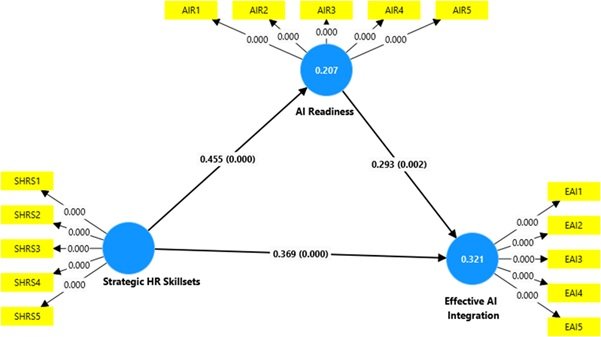
Figure 1: Structural Estimate
7. Discussion
The findings show that there are significant linkages between Strategic HR Skillsets and AI Readiness, meaning that HR professionals that possess digital literacy, AI literacy, change management capability, strategic alignment and data ethics awareness are more likely to be able to prepare organisations for the adoption of AI. These skills encourage employees to learn, mitigate opposition to technological shifts, and connect AI efforts with organizational goals, improving organizational readiness (Kim et al., 2025; Deepa et al., 2024). Moreover, the strong positive correlation between AI Readiness and Effective AI Integration implies that organizations that do well in terms of readiness such as having adequate infrastructure, people with the right skills, leadership that supports innovation, and an organizational culture that embraces new technologies – also perform better with regard to effective AI Integration. The mediating role of AI Readiness also suggests that Strategic HR Skillsets facilitate the successful integration of AI, thereby boosting AI Readiness. The results suggest that the use of AI should not be considered as a simple investment in technology but as a change management program within the organization. In conclusion, real estate companies need to focus on ongoing HR capability development, reskilling, ethical oversight of AI, and proactive change management to ensure sustainable digital transformation and ongoing competitive success.
8. Conclusion
This study applying PLS-SEM has aimed at assessing the impact of Strategic HR Skillsets on AI Readiness and Effective AI Integration in the real estate industry in Bangalore. The results showed that Strategic HR Skillsets have a significant impact on both AI Readiness and Effective AI Integration, and that AI Readiness acts as a partial mediator between Strategic HR Skillsets and Effective AI Integration. The measurement model showed good reliability, validity, and model fit, while the structural model results were satisfactory, confirming the robustness of the proposed model. The study underscores the critical importance of investing in HR-related skills, including AI literacy, digital skills, change management, strategic alignment, and ethical awareness, in addition to the investments in technology. The results have important implications for HR managers, managers and policy makers in the real estate industry regarding sustainable digital transformation and organizational competitiveness.
9. Contribution of the Study
The work has valuable theoretical and practical implications on the literature about the adoption of AI and strategic human resource management practices in the construction and real estate industry, which is still developing. In theory, it expands on the current frameworks of HR technology adoption that incorporate Strategic HR Skillsets, AI Readiness, and Effective AI Integration as one structural model. Although earlier works did the adoption of AI through technological or operations prism of AI, this study throws light on strategic value of HR competencies as a prerequisite facilitator of digital transformation. The study by making AI Readiness a mediating construct adds to the better understanding of how human capital capabilities lead to successful outcomes of AI implementation. The study has methodological contributions in that a well-developed and validated total measurement model is created to fit the real estate setting in Bangalore. The application of PLS-SEM can give empirical data on the direct and indirect correlations between HR skillsets, preparedness, and integration results. The digital literacy scale, AI literacy scale, change management capability scale, strategic alignment scale and data ethics awareness scale is a validated framework that can be modified to suit future studies in other industries and geographies. Practically, the research can give practical recommendations to real estate companies that want to increase the level of AI-based competitiveness. It highlights that the successful implementation of AI cannot only rely on the technological infrastructure but needs strategic HR leadership and the development of capabilities. The results influence policy makers, human resource managers, and organizational decision-makers to develop training programs, governance systems, and change initiatives that enhance AI preparedness and sustainability in the adoption of technology in the fast- paced real estate context in Bangalore.