
Entrepreneurship has become one of the most accepted ways of sustainable development, innovation, and inclusive, economic growth. Nevertheless, the conventional entrepreneurship theories tend to concentrate on short-term financial benefits rather than on the long-term benefits of the society. FinTech innovation, artificial intelligence and platform-based business models have significantly changed the business and brought new opportunities to the digital economy, but also new complex risks and ethical challenges.
Management students form an essential source of future entrepreneurs, but most of them are not ready to establish responsible business. Entrepreneurial intentions are formed by the manner in which leadership orientation and personal risk attitudes come into play. Sustainable leadership focuses on ethical governance, involvement of stakeholders and creation of long-term value whereas the risk aptitude identifies the readiness to act under uncertainty.
Whereas previous research is centered on psychological factors influencing entrepreneurial intention, the rest of the studies do not incorporate leadership values and digital preparedness. This paper fills this gap by suggesting an inclusive model that relates sustainable leadership, risk aptitude and responsible entrepreneurial intention in the digital environment.
2. Literature Review
Table 1. Selected Scopus Literature Supporting Model Constructs
Author(s) | Focus Area | Method | Key Findings | Relevance |
Avery & Bergsteiner (2011); Maak & Pless (2006) | Leadership & sustainability | Empirical | Ethical leaders promote long-term outcomes | Supports IV |
Stewart & Roth (2001); Zhao, Seibert & Lumpkin (2010) | Risk propensity | Survey | Risk tolerance predicts venture creation | Supports mediator |
Venkatesh et al. (2003); Nambisan (2017) | Technology readiness | Mixed methods | Digital capability reduces uncertainty | Supports moderator |
Kuckertz & Wagner (2010); Shepherd & Patzelt (2011) | Responsible ventures | SEM | Sustainability orientation increases intention | Supports DV |
The current business landscape in the entire world is experiencing a radical change that has been occasioned by digitalization, sustainability concerns, and changing societal demands. The concept of entrepreneurship, which traditionally has been linked to the identification of economic opportunities and maximization of profits, is gaining a new definition as the means of sustainable development. In this transition, the orientation of leadership, and risk behavior is introduced as the determinants of the responsible entrepreneurial action.
The Sustainable Leadership as a Reportable Entrepreneurship.
The notion of sustainable leadership has developed due to increasing worries on environmental degradation, inequality in the society, and corporate focus in the short term. Researchers state that sustainable leadership is based on such principles as ethical governance, inclusion of stakeholders, long term-strategy, and environmental awareness (Avery and Bergsteiner, 2011). In contrast to the traditional methods of leadership which were concerned only with financial performance, sustainable leadership emphasizes on the intergenerational value creation.
It has been empirically indicated that those leaders who adopt sustainability principles develop an environment of innovation and promote responsible decision making (Maak & Pless, 2006). These leaders determine the moral identity and pro-social orientation of the followers that is vital in the entrepreneurial setting (Waldman and Galvin, 2008). In addition, sustainable leadership increases the resilience and flexibility of organizations- which is paramount in a rapidly evolving digital market (Iqbal and Ahmad, 2021).
Green innovation and venture creation that focuses on social responsibility have been observed in sustainability-oriented leadership in entrepreneurial ecosystems (Hall, Daneke, and Lenox, 2010). The literature in sustainable entrepreneurship shows that leadership perceptions are of major importance in determining venture intentions among students and aspiring entrepreneurs (Shepherd and Patzelt, 2011). Therefore, sustainable leadership offers not only the moral foundation but also the orientation of responsible entrepreneurship.
Risk Aptitude and Action as an Entrepreneur.
Entrepreneurship is associated with uncertainty. Risk aptitude, which is the readiness of an individual to participate in the decision-making where the final results are unknown, has been traditionally considered as one of the most important entrepreneurial qualities (Stewart and Roth, 2001). Entrepreneurs are generally considered to have more risk tolerance than managers especially in cases where opportunities are identified more than perceived risks.
Nevertheless, the modern academic focus is on the idea that responsible entrepreneurship involves making risky decisions based on calculations and ethical judgment and not irresponsible actions. Zhao, Seibert and Lumpkin (2010) show that risk propensity is a strong predictor of entrepreneurship intention through self-efficacy. On the same note, Miner and Raju (2004) concluded that there is a stable result of risk preferences between entrepreneurs and non- entrepreneurs.
There is also a moderating effect of risk perception in the form of intention formation. When the perceived uncertainty is greater than the perceived capability, the individuals might opt not to venture into entrepreneurship (Sitkin and Pablo, 1992). In sustenance-oriented businesses, risk also has other aspects like regulatory uncertainty and stakeholder expectations. Thus, the leadership orientation might also shape the perceptions and treatment of the entrepreneurial risk by individuals.
Duty-Bearing Entrepreneurial Intention.
The Theory of Planned Behavior forms the theoretical basis of the entrepreneurial intention research to a great extent (Ajzen, 1991). This theory assumes that intention is affected by attitude, subjective norms and perceived behavioral control. Sustainable entrepreneurial intention goes beyond this model to include environmental and social value creation (Liñan, and Chen, 2009).
According to the research, sustainability education enhances business attitudes that are in line with responsible business models (Kuckertz and Wagner, 2010). People who are better ecologically oriented will tend to venture into sustainable activities (Schaltegger and Wagner, 2011). Moreover, sustainable venture intention is highly raised in the university environment that propagates ethical consciousness (Bacq & Alt, 2018).
According to the current literature, sustainability-focused entrepreneurship is especially applicable in digitally enabled economies, in which platform technologies make possible scalable impact solutions (George, Merrill, and Schillebeeckx, 2021).
Digital Preparedness and the New Business Environment.
With digital transformation, barriers to entry have been minimized as well as opportunity structures. Using FinTech innovations, artificial intelligence, and ecosystems built on platforms, entrepreneurs reduce uncertainty by making decisions based on data (Nambisan, 2017).
Technology preparedness positively affects perceived behavioral control and perceived risk (Venkatesh et al., 2003). Digital capability enhances resilience, as well as boosts the spread of sustainable innovation (Autio et al., 2018). Digital infrastructure in emerging markets has a major role of enhancing confidence and inclusivity of entrepreneurship (Yoo, Henfridsson, and Lyytinen, 2010).
Although there is increasing evidence of digital transformation and entrepreneurship and the convergence, very little literature has incorporated digital readiness with psychological risk aptitude and leadership orientation in the single sustainability framework.
Identified Research Gap
Although sustainable leadership, entrepreneurial risk-taking, and sustainable intention are researched separately, little is known regarding empirical integration of these constructs. In addition, the mediating stage of digital preparedness in this association has not been addressed adequately by scholars.
The research is a response to the demand of multidimensional schemes integrating ethical leadership, psychological determinants, and digital transformation in the model of explaining responsible entrepreneurial intention in the globalized economy.
3. Research Objectives:
- To examine the influence of sustainable leadership on risk aptitude.
- To analyse the relationship between risk aptitude and responsible entrepreneurial intention.
- To evaluate the direct effect of sustainable leadership on entrepreneurial intention.
- To study the meditating role of risk aptitude.
- To investigate the moderating role of digital readiness.
4. Conceptual Model: Proposed Structural Model
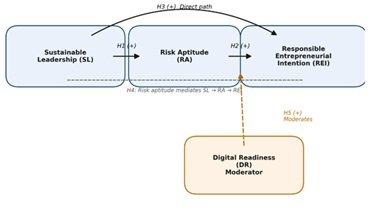
Figure 1. Proposed structural model showing the hypothesized paths (H1–H5).
5. Hypotheses of the study
H1: Sustainable leadership positively influences risk aptitude.
H2: Risk aptitude positively influences responsible entrepreneurial intention.
H3: Sustainable leadership positively influences responsible entrepreneurial intention.
H4: Risk aptitude mediates the relationship between sustainable leadership and responsible entrepreneurial intention
H5: Digital readiness moderates the relationship between risk aptitude and responsible entrepreneurial intention.
6. Methodology
- Research Design: Quantitative survey design.
- Data Collection:
- Primary Data: Primary data collected from BBA/MBA students using structured questionnaire by using five-point Likert scale
- Secondary Data: Secondary data collected from various journals, articles and validated sources
- Sample Size: 318 BBA/MBA students from management institutions.
Table 2. Frequency Distribution of Sample Demographic Profile (N = 318)
Demographic Variable | Category | Frequency (n) | Percentage (%) |
Age (years) | 18–20 | 250 | 78.62 |
21–23 | 50 | 15.72 | |
24–26 | 18 | 5.66 | |
Total |
| 318 | 100.0 |
Gender | Male | 118 | 37.17 |
Female | 200 | 62.89 | |
Total |
| 318 | 100.0 |
Educational Stream | BBA | 205 | 64.46 |
MBA | 113 | 35.54 | |
Total | 318 | 100.0 | |
Semester | I–II | 125 | 39.31 |
III–IV | 128 | 40.25 | |
V–VI | 65 | 20.44 | |
Total | 318 | 100.0 |
- Measurement: Five-point Likert scale instruments adapted from validated sources.
Table 3. Measurement Constructs
Construct | Items | Source Type |
Sustainable Leadership | 5 | Leadership scales |
Risk Aptitude | 4 | Risk propensity scales |
Digital Readiness | 4 | Technology readiness |
Responsible Entrepreneurial Intention | 5 | Sustainability intention scales |
7. Data Analysis and Results
7.1 Reliability and Validity
Table 4. Reliability and Validity Indices
Construct | Cronbach’s Alpha | CR | AVE |
Sustainable Leadership | 0.89 | 0.91 | 0.66 |
Risk Aptitude | 0.86 | 0.88 | 0.64 |
Digital Readiness | 0.88 | 0.90 | 0.68 |
Entrepreneurial Intention | 0.92 | 0.93 | 0.71 |
All values exceed recommended thresholds of 0.70, confirming reliability and convergent validity. The AVE values are above 0.50, indicating satisfactory convergent validity. These results confirm that the measurement model is statistically reliable and valid.
7.2 Structural Model Results (Hypothesis Testing)
Table 5. SEM Path Results
Hypothesis | Path | β | p-value | Result |
H1 | SL → RA | 0.62 | <0.001 | Supported |
H2 | RA → REI | 0.48 | <0.001 | Supported |
H3 | SL → REI | 0.35 | <0.01 | Supported |
H4 | SL → RA → REI | — | — | Partial mediation |
H5 | RA × DR → REI | 0.21 | <0.05 | Supported |
Table 6. Structural Model Fit Indices
Fit Index | Recommended Threshold | Obtained Value | Interpretation |
χ²/df | ≤ 3.00 | 2.18 | Good Fit |
GFI | ≥ 0.90 | 0.93 | Good Fit |
AGFI | ≥ 0.90 | 0.91 | Good Fit |
CFI | ≥ 0.90 | 0.95 | Good Fit |
TLI (NNFI) | ≥ 0.90 | 0.94 | Good Fit |
RMSEA | ≤ 0.08 | 0.056 | Good Fit |
SRMR | ≤ 0.08 | 0.049 | Good Fit |
The SEM findings show that sustainable leadership has a significant impact on risk aptitude and responsible entrepreneurial intention. Risk propensity also positively influences entrepreneurial intention thus supporting the importance of calculated risk-taking behavior. Furthermore, digital readiness moderates the effect of risk attitude on entrepreneurial intention, pointing to the significance of technological competence in contemporary entrepreneurship.
Hypothesis-wise Analysis
- H1 Analysis: It is important to note that sustainable leadership enhances the willingness of people to take calculated risks. Leaders who focus on long-term sustainability seem to be more certain about managing uncertainty.
- H2 Analysis: The predictive of wanton entrepreneurial intention is highly predictive of risk aptitude, which may denote that those who endure uncertainty are more prone to venture into new enterprises.
- H3 Analysis: Direct implications demonstrate that leaders who are sustainability oriented have intrinsic motivation being made towards responsible entrepreneurship.
- H4 Analysis (Mediation): There is a partial mediation between leadership-intention and risk aptitude, which implies that leadership has a direct and indirect impact on leadership intention via psychological risk orientation.
- H5 Analysis (Moderation): Digital preparedness enhances the impact of risk aptitude on intention, emphasizing the influences of digital resources in the mitigation of the perceived uncertainty.
8. Findings
- Sustainable leadership is a close predictor of risk aptitude and the intention to become an entrepreneur.
- Risk aptitude is a major mediating factor.
- Digital preparedness increases readiness to take entrepreneurship action.
- Sustainable creation of ventures requires integrated leadership and digital competencies.
9. Discussion
The results prove that the leadership values, psychological characteristics, and technological ability combine to represent responsible entrepreneurship in the digital economy. Sustainable leadership encourages ethical risk-taking, and digital readiness offers the means with which to handle the uncertainty successfully.
10. Conclusion
In its contribution to the entrepreneurship literature, this research suggests and confirms the integrated model on the relationship between sustainable leadership, risk aptitude, and digital readiness and responsible entrepreneurial intention. Following the digital economy that changes the business landscapes, it is crucial to encourage leaders who are sustainability-focused and can take risks that are guided by calculations to enable them to encourage the development that is inclusive and long-term.
Future entrepreneurs need to be trained on sustainability, leadership, and skills in digital technologies to ensure they are accountable in innovation; therefore, institutional policies and incubators should focus on these education areas.