Edumania-An International Multidisciplinary Journal
Vol. 04, Issue 03 (Jul-Sep 2026)
An International scholarly/ academic journal, peer-reviewed/ refereed journal, ISSN : 2960-0006
Bridging Science, Society, and Language: Rethinking English Pedagogy in Karnataka’s Agricultural Universities
T., Ramaswamy
Research Scholar, Department of Studies and Research in English, Tumkur University, Tumakuru, Karnataka, India
Abstract
English language pedagogy in Karnataka’s agricultural universities occupies a critical position at the intersection of scientific knowledge production, rural development, and global academic engagement. While English serves as the primary medium for research dissemination, professional communication, and policy articulation in agricultural sciences, a majority of students enrolled in these institutions come from Kannada-medium, rural, and first-generation learner backgrounds. This linguistic transition often produces pedagogic tensions that affect disciplinary comprehension, extension communication, and meaningful participation in academic discourse.The paper re-conceptualizes English teaching in Karnataka’s agricultural universities as a mediational and translational practice that bridges scientific discourse and societal realities. Drawing on curriculum analysis, classroom observations, and student learning experiences across institutions such as University of Agricultural Sciences, Bangalore, University of Agricultural Sciences, Dharwad, University of Agricultural Sciences, Raichur, KeladiShivappa Nayaka University of Agricultural and Horticultural Sciences, Shivamogga, University of Horticultural Sciences, Bagalkot, and University of Agricultural Sciences, Mandya, the study engages with multilingual education theory, translanguaging frameworks, and science communication research to challenge deficit-oriented models of language instruction.The analysis reveals that existing English curricula remain largely de-contextualized from agricultural disciplines and rural communication needs. In response, the paper proposes pedagogic imperatives that integrate disciplinary content, legitimize multilingual resources, foster translational competence, and incorporate digital literacy and sustainability communication. Such an approach aligns English pedagogy with broader goals of social inclusion, knowledge democratization, and science–society engagement.By repositioning English not merely as a gatekeeping academic requirement but as a transformative communicative tool, the study argues for a context-sensitive model of language education that enhances inclusivity, empowers rural learners, and strengthens the societal impact of agricultural knowledge in a digitally connected and multilingual world.
Keywords: English Language Teaching, Agricultural Universities, Multilingual Pedagogy, Science Communication, Translanguaging, Sustainability.
About Author
Mr. Ramaswamy T is a Research Scholar in the Department of Studies and Research in English, Tumkur University, Tumakuru, Karnataka, India. His research interests include English Language Teaching (ELT), Postcolonial Studies, Indian Writing in English, Higher Education, and Language Pedagogy, with a particular focus on English language education in agricultural and rural academic contexts.
Impact Statement
This study contributes to ongoing debates on multilingual higher education, science communication, and socially responsive pedagogy by re-conceptualizing English teaching in Karnataka’s agricultural universities as a mediational bridge between scientific knowledge and rural society. Through field-based analysis across multiple agricultural institutions, the paper demonstrates how language pedagogy directly influences disciplinary participation, extension effectiveness, digital inclusion, and sustainability communication. The proposed integrated agricultural pedagogy offers a context-sensitive framework that combines multilingual practices, translanguaging, disciplinary literacy, digital communication, and sustainability-oriented discourse. The study has practical implications for curriculum developers, policymakers, English language teachers, and agricultural universities seeking to reduce linguistic inequality and strengthen socially inclusive knowledge dissemination. By aligning English pedagogy with agriculture-specific communication and rural engagement, the study advocates a transformative model of language education capable of supporting equitable participation in contemporary scientific and digital knowledge systems.
Cite This Article
APA 7th Edition: Ramaswamy, T. (2026). Bridging Science, Society, and Language: Rethinking English Pedagogy in Karnataka’s Agricultural Universities. Edumania-An International Multidisciplinary Journal, 4(3), 320-334. https://doi.org/10.59231/edumania/9239
MLA 9th Edition: Ramaswamy, T. “Bridging Science, Society, and Language: Rethinking English Pedagogy in Karnataka’s Agricultural Universities.” Edumania-An International Multidisciplinary Journal, vol. 4, no. 3, 2026, pp. 320-334. https://doi.org/10.59231/edumania/9239.
Chicago 17th Edition: Ramaswamy, T. 2026. “Bridging Science, Society, and Language: Rethinking English Pedagogy in Karnataka’s Agricultural Universities.” Edumania-An International Multidisciplinary Journal 4 (3): 320-334. https://doi.org/10.59231/edumania/9239.
DOI: https://doi.org/10.59231/edumania/9239
Page Numbers: 320 – 334
Subject: English Language Teaching, Agricultural Universities, Multilingual Pedagogy, Science Communication, Translanguaging, Sustainability
Received: Mar 08, 2026
Accepted: May 15, 2026
Published: Jul 05, 2026
Thematic Classification: Agricultural Higher Education, English Pedagogy, Multilingualism in Higher Education, Sustainable Development, and Academic Communication.
Introduction
Agricultural universities in Karnataka function as critical knowledge institutions linking scientific innovation, rural livelihoods, sustainability initiatives, and policy frameworks. Modeled on the United States’ land-grant university system, agricultural universities in India and institutions such as University of Agricultural Sciences, Bangalore and University of Agricultural Sciences, Dharwad were established to integrate teaching, research, and extension in order to modernize agriculture and enhance rural development. Yet within this triadic mandate, language remains an under-theorized dimension.
English has become the dominant medium of agricultural research publication, academic documentation, digital communication, and professional advancement. However, a majority of students enrolled in Karnataka’s agricultural universities originate from Kannada-medium schooling backgrounds, rural agrarian families, and first-generation higher education contexts. This sociolinguistic reality produces a pedagogic paradox: while English is indispensable for accessing global scientific knowledge, its structural dominance can reproduce educational inequality.
The paper argues that English pedagogy must be re-conceptualized as an epistemic and socio-cultural bridge between science and society rather than as a narrow linguistic competency requirement. Situated within contemporary debates on multilingualism, digital transformation, sustainability communication, and social justice, the study foregrounds Karnataka’s agricultural universities as crucial sites for rethinking English language education in India.
1.1 Research Gap
Although several studies have examined English language teaching in Indian higher education, limited scholarly attention has been given to English pedagogy within agricultural universities, particularly in the context of Karnataka. Existing research on agricultural higher education largely prioritizes scientific training, extension systems, and technical competency, while the role of language pedagogy in mediating scientific knowledge remains underexplored.
Similarly, many studies on English language teaching in India focus primarily on employability, communicative competence, or English for Specific Purposes (ESP), without sufficiently examining how language functions within agriculture-specific knowledge systems, rural communication networks, and multilingual learning environments.
Furthermore, there is inadequate research investigating how students from Kannada-medium and rural educational backgrounds negotiate English-dominant scientific discourse in agricultural institutions. Existing curricular models often overlook translanguaging practices, extension communication requirements, sustainability discourse, and digital agricultural communication. Consequently, the relationship between English pedagogy, scientific knowledge dissemination, and rural societal engagement remains insufficiently theorized in the context of Karnataka’s agricultural universities.
1.2 Problem Statement
Despite English functioning as the dominant language of scientific communication, research publication, digital agricultural technologies, and academic advancement, the majority of students enrolled in Karnataka’s agricultural universities come from rural, Kannada-medium, and first-generation educational backgrounds. This creates a pedagogic and epistemic disconnect between students’ linguistic realities and institutional expectations.
The existing English curriculum in many agricultural universities remains largely grammar-oriented and decontextualized from agricultural disciplines, extension communication, sustainability concerns, and multilingual classroom realities. As a result, students frequently experience difficulty participating in academic discourse, interpreting scientific materials, engaging in extension communication, and accessing digital agricultural knowledge systems. The lack of agriculture-specific and multilingual pedagogical approaches limits the effectiveness of English instruction in fulfilling the broader social and scientific mission of agricultural universities.
1.3 Objectives of the Study
The present study aims to:
Examine the role of English pedagogy in Karnataka’s agricultural universities within the context of scientific communication and rural engagement.
Analyze the linguistic and communicative challenges faced by students from Kannada-medium and rural educational backgrounds.
Investigate the role of translanguaging and multilingual practices in agricultural classrooms.
Evaluate the relevance of existing English curricula in relation to agricultural disciplinary communication.
Propose an integrated pedagogical framework that aligns English teaching with agricultural knowledge dissemination, sustainability communication, and digital literacy.
2. Literature Review
2.1 English and Linguistic Capital in Higher Education
The global dominance of English in academia has been extensively documented. Phillipson conceptualizes English as a form of linguistic imperialism that reinforces structural inequalities in knowledge production (Phillipson 47). Similarly, Bourdieu’s notion of linguistic capital illuminates how proficiency in dominant languages functions as symbolic power within institutional fields (Bourdieu 55). In agricultural higher education, English operates as the language of journals, international collaborations, grant proposals, and global scientific legitimacy.
In the Indian context, Ramanathan argues that English mediates access to professional mobility while simultaneously producing stratification (Ramanathan 112). Agricultural universities, serving largely rural populations, become sites where this stratification is sharply visible. Students with limited prior exposure to English often experience epistemic marginalization despite strong disciplinary aptitude.
2.2 Multilingualism and Translanguaging
Recent multilingual education scholarship challenges monolingual instructional models. García and Li Wei conceptualize translanguaging as the dynamic deployment of integrated linguistic repertoires rather than compartmentalized languages (García and Li Wei 21). This perspective reframes bilingual practices as cognitive resources rather than deficiencies.
Canagarajah further advances translingual practice as an orientation that negotiates meaning across linguistic boundaries (Canagarajah 62). In agricultural classrooms across Karnataka, students routinely interpret English technical terminology through Kannada conceptual frameworks. Such translanguaging practices facilitate comprehension and collaborative learning.
Cummins’ theory of common underlying proficiency suggests that conceptual knowledge developed in one language transfers to another (Cummins 38). Therefore, acknowledging Kannada as a cognitive scaffold enhances rather than diminishes English acquisition.
2.3 English as Gatekeeping Mechanism
English proficiency often functions as an institutional filter in higher education. Hyland argues that academic discourse communities regulate legitimacy through genre conventions (Hyland 9). Students unfamiliar with these conventions may struggle to demonstrate disciplinary knowledge despite substantive understanding.
In agricultural universities, this dynamic is amplified. Technical vocabulary, research reporting norms, and digital documentation requirements are heavily English-centric. Without contextualized instruction, English becomes a gatekeeping mechanism rather than a communicative bridge.
2.4 Science Communication and Public Engagement
Science communication research emphasizes the importance of translating technical knowledge into accessible discourse for public audiences. Burns et al. define science communication as the use of appropriate skills and media to produce public awareness and engagement (Burns 183). Agricultural graduates are expected to communicate with farmers, cooperatives, NGOs, and policymakers—audiences often more comfortable in regional languages.
Thus, English pedagogy must integrate translational competence that enables students to move between scientific English and local communicative contexts.
2.5 Digital Literacy and Knowledge Dissemination
The digital transformation of agriculture—through AI advisory systems, climate forecasting tools, online extension portals, and mobile applications—demands new communicative competencies. Warschauer argues that digital inclusion is inseparable from language competence (Warschauer 45). Without integrating digital literacy into English instruction, agricultural universities risk preparing graduates inadequately for contemporary knowledge ecosystems.
2.6 Sustainability and Education
Education for sustainable development requires interdisciplinary communication and ethical engagement. Sterling contends that sustainability education must move beyond technical training toward transformative learning (Sterling 34). English classrooms can contribute to sustainability discourse by training students to articulate environmental concerns, climate adaptation strategies, and rural development policies effectively.
3. Research Methodology
3.1 Research Design
The study adopts a qualitative, interpretive research design grounded in educational ethnography and curriculum analysis. The objective is to examine how English pedagogy operates within Karnataka’s agricultural universities and how it aligns—or fails to align—with disciplinary and societal communicative demands.
3.2 Field Sites
Field engagement was conducted across selected campuses of:
University of Agricultural Sciences, Bangalore
University of Agricultural Sciences, Dharwad
University of Agricultural Sciences, Raichur
University of Horticultural Sciences, Bagalkot
KeladiShivappa Nayaka University of Agricultural and Horticultural Sciences, Shivamogga
University of Agricultural Sciences, Mandya
These institutions represent diverse agro-climatic and socio-economic contexts within Karnataka.
3.3 Data Collection
Data were collected through:
Curriculum document analysis (English syllabi, course outlines, assessment patterns)
Classroom observations (20 sessions across institutions)
Semi-structured interviews with 18 students and 8 English faculty members
Informal discussions with extension coordinators
The interviews explored students’ linguistic backgrounds, classroom experiences, communicative challenges, and professional aspirations.
3.4 Data Analysis
Data were coded thematically using interpretive content analysis. Key themes included:
Linguistic transition challenges
Translanguaging practices
Curriculum relevance
Extension communication needs
Digital literacy gaps
The analysis sought to identify structural patterns rather than isolated experiences.
4. Karnataka-Specific Sociolinguistic Framing
Across the sampled institutions, approximately 40–50% of interviewed students reported Kannada as their primary medium of schooling. Many described English exposure as limited to textbook-based grammar instruction without communicative practice. Upon entering agricultural universities, they encountered English-dominant lectures, laboratory manuals, and digital platforms.
Classroom observations revealed frequent bilingual negotiation. Students often requested explanations in Kannada to clarify technical terms such as “integrated pest management,” “soil microbiology,” or “climate-resilient cropping systems.” Teachers responded by strategically code-switching despite formal curricular expectations of English-only instruction.
Students also reported difficulty drafting extension reports intended for farmer outreach. While they could conceptually understand agricultural processes, articulating them in formal English proved challenging. This gap highlights the misalignment between English curriculum design and agriculture-specific communicative needs.
5. Thematic Data Analysis
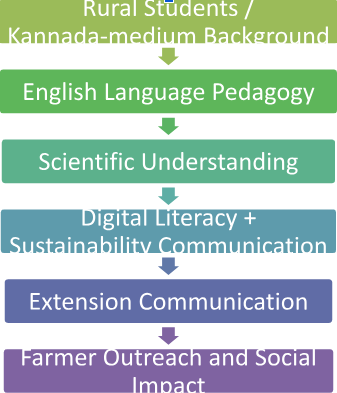
The qualitative data generated through curriculum review, classroom observation, and interviews across Karnataka’s agricultural universities reveal five interrelated thematic clusters: (1) linguistic transition and epistemic anxiety, (2) informal translanguaging as cognitive mediation, (3) curriculum–discipline misalignment, (4) extension communication inadequacy, and (5) digital communicative gaps.
Table 1: Major Themes Emerging from Qualitative Data Analysis
Theme | Evidence from Field Data | Pedagogic Implication |
Linguistic Transition Anxiety | Students hesitated to participate in English-medium discussions | Need for confidence-oriented multilingual pedagogy |
Translanguaging Practices | Frequent use of Kannada for conceptual clarification | Recognition of bilingual learning strategies |
Curriculum–Discipline Misalignment | English courses focused mainly on grammar and résumé writing | Need for agriculture-specific communication training |
Extension Communication Gap | Students struggled to translate scientific concepts for farmers | Inclusion of translational and extension communication tasks |
Digital Literacy Challenges | Difficulty interpreting English-based agricultural digital platforms | Integration of digital communication skills into English curriculum |
Sustainability Communication Gap | Limited exposure to environmental and climate discourse | Need for sustainability-oriented communication modules |
Figure 1: Relationship between English Pedagogy, Science Communication, and Rural Engagement
5.1 Linguistic Transition and Epistemic Anxiety
A dominant theme emerging from student interviews was what may be described as “epistemic anxiety.” Students frequently reported that difficulty in articulating ideas in English was perceivedby themselves and sometimes by peersas intellectual inadequacy. One student at UAS Dharwad remarked that although he understood agronomic practices conceptually, he hesitated to participate in class discussions due to fear of grammatical errors. This aligns with Bourdieu’s argument that linguistic competence often functions as symbolic capital within institutional spaces (Bourdieu 55). In such contexts, English proficiency becomes conflated with intellectual legitimacy.
The data indicate that English operates simultaneously as an enabling resource and as a psychological barrier. This duality reinforces Phillipson’s contention that dominant languages often structure academic hierarchies (Phillipson 47). However, the anxiety expressed by students is not rooted in conceptual inability but in performative expectations tied to monolingual academic norms.
5.2 Translanguaging as Cognitive Mediation
Despite institutional emphasis on English-medium instruction, classroom observations demonstrated frequent and strategic translanguaging. Teachers routinely explained complex agricultural terminology in Kannada before returning to English discourse. Peer discussion groups also relied on bilingual negotiation to process laboratory instructions and field reports.
These findings substantiate García and Li Wei’s assertion that translanguaging is a natural and productive cognitive practice in multilingual classrooms (García and Li Wei 21). Rather than undermining English acquisition, translanguaging appeared to enhance disciplinary comprehension. Cummins’ theory of cross-linguistic transfer supports this interpretation, suggesting that conceptual understanding developed in one language strengthens learning in another (Cummins 38).
However, translanguaging practices remained unofficial and unacknowledged in formal assessment structures. This disjuncture between pedagogic reality and curricular ideology highlights the need for institutional recognition of multilingual strategies.
5.3 Curriculum–Discipline Misalignment
Analysis of English syllabi across institutions revealed limited integration with agricultural disciplines. Course components emphasized grammar correction, résumé writing, and generic presentation skills. While these competencies are important, they do not sufficiently address agriculture-specific communicative tasks.
Students reported minimal training in drafting farmer advisories, interpreting climate reports, or translating research findings into accessible formats. Hyland’s argument that academic literacy must be situated within disciplinary communities becomes particularly relevant here (Hyland 9). Without disciplinary contextualization, English instruction remains abstract and detached from professional realities.
The absence of sustainability-oriented discourse in English curricula also emerged as a significant gap. Given Karnataka’s vulnerability to climate variability and agrarian distress, communicative training in sustainability reporting and environmental advocacy is critical.
5.4 Extension Communication and Public Engagement
Agricultural universities in Karnataka are mandated to conduct extension activities connecting research with farming communities. Yet students reported feeling underprepared to communicate scientific knowledge effectively beyond academic settings. While technical reports were written in English, interactions with farmers typically required Kannada or regional dialects.
This communicative shift demands translational competence: the ability to convert technical English discourse into culturally resonant and accessible language. Burns et al. emphasize that science communication requires not only accuracy but audience sensitivity (Burns 183). The data suggest that current English pedagogy does not sufficiently cultivate this skill.
Freire’s dialogic model of education offers a valuable framework for addressing this gap (Freire 72). By conceptualizing English classrooms as dialogic spaces that rehearse real-world communicative engagement, institutions can better prepare graduates for extension roles.
5.5 Digital Communication and Technological Mediation
The rapid digitization of agricultural servicesthrough mobile advisory apps, climate forecasting dashboards, and online research repositoriesintroduces new communicative demands. Students acknowledged reliance on English-language digital platforms for accessing scientific literature and weather data. However, many expressed difficulties composing digital content or interpreting technical documentation independently.
Warschauer argues that digital literacy is inseparable from linguistic competence in contemporary education (Warschauer 45). The data from Karnataka institutions confirm this interdependence. English pedagogy that neglects digital communication risks limiting graduates’ ability to participate fully in evolving agricultural knowledge systems.
Table 2: Traditional Pedagogy vs. Proposed Integrated Agricultural Pedagogy
Traditional English Pedagogy | Proposed Integrated Agricultural Pedagogy |
Grammar-centered instruction | Discipline-integrated communication training |
Emphasis on correctness and examination performance | Emphasis on communicative effectiveness and knowledge mediation |
English-only instructional ideology | Multilingual and translanguaging-oriented pedagogy |
Generic communication exercises | Agriculture-specific communication tasks |
Limited relation to rural contexts | Integration of farmer outreach and extension communication |
Minimal digital communication training | Digital agricultural literacy and AI-assisted communication |
Focus on employability alone | Focus on social engagement, sustainability, and scientific dissemination |
Language treated as isolated subject | Language treated as epistemic and social bridge |
6. Discussion: Navigating the Nexus of Language, Sustainability, and Digital Transformation
The findings situate English pedagogy within a broader nexus linking scientific innovation, digital transformation, sustainability, and society. The conference theme emphasizes the interconnection of technology, sustainability, and global engagement. In Karnataka’s agricultural universities, English functions as the linguistic infrastructure enabling participation in this nexus.
First, digital transformation intensifies the centrality of English in accessing online research databases, AI-based advisory tools, and global climate models. However, without multilingual mediation, such access remains uneven. Integrating translanguaging into digital literacy training can democratize knowledge access.
Second, sustainability communication requires the ability to articulate complex environmental issues in accessible forms. English classrooms can incorporate tasks such as drafting climate adaptation briefs, sustainability reports, and extension scripts tailored to rural audiences. Sterling’s conception of transformative education underscores the need for interdisciplinary communicative competence (Sterling 34).
Third, linguistic inclusion aligns with social justice objectives. Recognizing Kannada as a cognitive resource challenges monolingual academic hierarchy and affirms students’ linguistic identities. This repositioning resonates with Ramanathan’s critique of English-driven stratification in Indian education (Ramanathan 112).
Ultimately, English pedagogy must shift from a corrective paradigm to a mediational paradigm—one that integrates disciplinary knowledge, multilingual practice, and digital competence.
7. Policy Implications for Karnataka’s Agricultural Universities
The study suggests several policy-oriented directions. Curriculum redesign should embed agriculture-specific communicative tasks within English courses. Modules on extension writing, sustainability communication, and digital agricultural documentation should become core components.
Teacher training programs should incorporate multilingual pedagogic strategies, legitimizing translanguaging as a structured instructional approach rather than an informal accommodation. Assessment frameworks must also evolve to evaluate communicative effectiveness rather than purely grammatical accuracy.
Institutional collaboration between English departments and agricultural science faculties can facilitate interdisciplinary course design. Such collaboration would align language instruction with research and extension mandates.
8. Recommendations
Based on the findings of the study, the following recommendations are proposed for strengthening English pedagogy in Karnataka’s agricultural universities:
8.1 Curriculum Reorientation
English curricula should move beyond grammar-oriented and generic communication models by incorporating agriculture-specific communicative tasks such as extension report writing, climate communication, sustainability discourse, scientific translation, and digital agricultural communication.
8.2 Integration of Translanguaging Practices
Agricultural universities should formally recognize multilingual pedagogic practices. Kannada and other regional linguistic resources should be viewed as cognitive and pedagogic assets rather than barriers to English learning.
8.3 Interdisciplinary Collaboration
English departments and agricultural science faculties should collaboratively design communication modules that align language learning with scientific and extension activities.
8.4 Digital Literacy Training
English pedagogy should incorporate training in digital agricultural platforms, AI-assisted communication tools, online scientific databases, and digital extension systems to prepare students for contemporary agricultural knowledge ecosystems.
8.5 Sustainability and Rural Communication
Students should be trained to communicate sustainability issues, climate adaptation strategies, and agricultural innovations effectively to diverse rural audiences. This will strengthen the societal relevance of agricultural education.
8.6 Assessment Reform
Assessment practices should evaluate communicative effectiveness, disciplinary understanding, and audience-oriented communication rather than focusing exclusively on grammatical accuracy.
8.7 Faculty Development Programs
Teacher training programs should equip English faculty members with multilingual pedagogic strategies, translanguaging methodologies, and interdisciplinary communication approaches relevant to agricultural education.
9. Conclusion
The study demonstrates that English pedagogy in Karnataka’s agricultural universities cannot be understood merely as language instruction detached from disciplinary and social realities. Rather, it functions within a complex network connecting scientific knowledge production, multilingual classroom interaction, digital transformation, sustainability communication, and rural societal engagement. The findings reveal that existing pedagogic models remain insufficiently aligned with the communicative needs of agricultural students, particularly those from Kannada-medium and first-generation educational backgrounds.
The data demonstrate that while English is indispensable for global academic engagement, its monolingual implementation risks reinforcing structural inequalities. Translanguaging practices already present in classrooms offer a foundation for inclusive pedagogy.
Reimagining English as a mediational bridge rather than a gatekeeping mechanism enables more equitable access to scientific knowledge. By integrating disciplinary alignment, digital literacy, sustainability discourse, and multilingual inclusion, agricultural universities can strengthen their science–society mandate.
In a globalized yet linguistically diverse educational landscape, such reorientation is not merely desirable but essential for inclusive and sustainable development.
Statements & Declarations
Authors’ Contribution: Ramaswamy T. served as the sole primary investigator and author of this study. He designed the structural conceptual framework linking English pedagogy to agricultural science communication, conducted the qualitative literature synthesis, curated the operational datasets, and drafted, revised, and executed the final manuscript for publication.
Peer Review: This article has undergone a rigorous double-blind peer-review process by the internal editorial board and external subject-matter experts of Edumania: An International Multidisciplinary Journal to verify its empirical authenticity, scholarly parameters, and practical relevance to the fields of linguistics and higher education.
Competing Interests: The author declares that he has no known financial, institutional, or personal competing interests that could have appeared to influence the research design, analytical findings, or conclusions presented in this work.
Funding: The author declares that no external financial assistance, institutional grants, or economic sponsorships were received from any public, corporate, or non-profit sector for the preparation, execution, or publication of this manuscript.
Data Availability: The qualitative source materials, structural texts, and textual records that support the analytical findings of this study are available upon reasonable request from the corresponding author, adhering to institutional and ethical standards of data transparency.
Ethical Approval: This study was conducted in strict adherence to the foundational ethical standards of the Department of Studies and Research in English, Tumkur University, alongside national guidelines governing qualitative educational research and structural literary reviews.
License: License © 2026 International Council for Education Research and Training. This work is published under a Creative Commons Attribution-NonCommercial-NoDerivatives 4.0 International License (CC BY-NC-ND 4.0), which permits users to copy and distribute the material in any medium or format in unadapted form only, for noncommercial purposes only, and only so long as attribution is given to the creator.
References
Bourdieu, Pierre. Language and Symbolic Power. Harvard UP, 1991.
Burns, Terry, et al. “Science Communication: A Contemporary Definition.”
Public Understanding of Science, vol. 12, 2003, pp. 183–202.
Canagarajah, A. Suresh. Translingual Practice. Routledge, 2013.
Cummins, Jim. Language, Power and Pedagogy. Multilingual Matters, 2000.
Freire, Paulo. Pedagogy of the Oppressed. Continuum, 1970.
García, Ofelia, and Li Wei. Translanguaging. Palgrave Macmillan, 2014.
Hyland, Ken. Disciplinary Discourses. Longman, 2000.
Phillipson, Robert. Linguistic Imperialism. Oxford UP, 1992.
Ramanathan, Vaidehi. The English-Vernacular Divide. Multilingual Matters, 2005.
Sterling, Stephen. Sustainable Education. Green Books, 2001.
Warschauer, Mark. Technology and Social Inclusion. MIT Press, 2003.