The concept of Free, Prior and Informed Consent (FPIC) has emerged as a cornerstone in the evolving landscape of Business and Human Rights (BHR), particularly in relation to the protection of Indigenous peoples’ rights over land, resources, and self-determination. Rooted in international legal instruments such as the United Nations Declaration on the Rights of Indigenous Peoples (UNDRIP) and ILO Convention No. 169, FPIC reflects a growing global commitment to ensuring that Indigenous communities are not merely consulted but are active decision-makers in matters affecting their lives and territories. However, despite its normative significance, the interpretation and implementation of FPIC remain contested, with UNDRIP emphasizing consent as a substantive right, while ILO 169 frames it largely as a procedural obligation of consultation. This divergence has led to varied judicial approaches across jurisdictions, particularly in the context of development projects and corporate activities. Against this backdrop, the present study examines how courts between 2020 and 2026 have interpreted and applied FPIC, highlighting emerging trends, challenges, and implications for both Indigenous rights and corporate accountability.
FPIC is the right of Indigenous peoples to be properly informed and to freely approve or reject projects that affect their lands, resources, and livelihoods before those projects begin.
Importance of FPIC:
Protects land and resource rights
Ensures self-determination
Prevents forced displacement and exploitation
Promotes fair and inclusive development.
Key Idea in Law
Under ILO Convention 169 → FPIC is legally binding for countries that ratified it.
Under United Nations Declaration on the Rights of Indigenous Peoples → FPIC is a global standard (soft law) but widely used by courts.
Conceptual Framework of FPIC
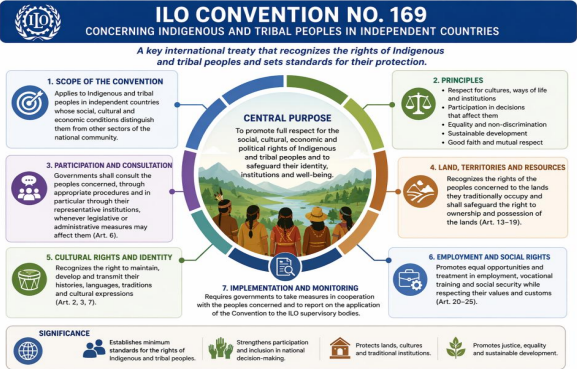
Under ILO Convention 169 (Article 6): FPIC is primarily framed as a duty to consult Indigenous communities before adopting measures affecting them.
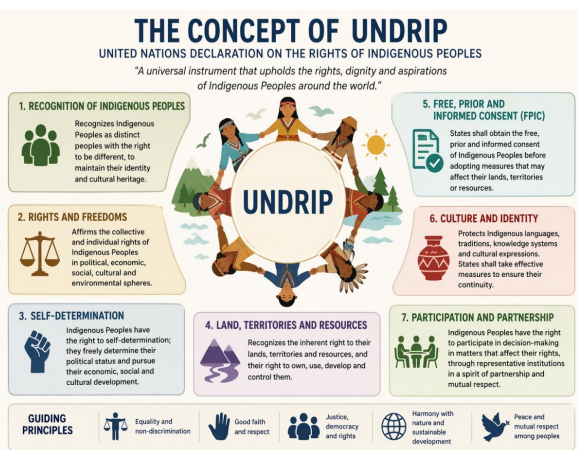
Under UNDRIP (Articles 10, 19, 32): FPIC is elevated toward a right to consent, particularly in cases of relocation or large-scale development.
Judicial bodies have interpreted FPIC along a spectrum:
Consultation (procedural obligation)
Consent (substantive right in high-impact cases).

I (a) RESEARCH QUESTION
How have judicial bodies between 2020 and 2026 interpreted and applied the principle of Free, Prior and Informed Consent (FPIC) under UNDRIP and ILO Convention No. 169, and to what extent do these interpretations shift the standard from consultation toward substantive consent in the context of Business and Human Rights? (
1(b) RESEARCH GAP
Existing literature recognizes Free, Prior and Informed Consent (FPIC) as a fundamental right of Indigenous peoples under both the United Nations Declaration on the Rights of Indigenous Peoples (UNDRIP) and ILO Convention No. 169. However, most studies examine these instruments separately and primarily discuss their legal principles. Limited attention has been given to a comparative analysis of how courts interpret and apply FPIC under both frameworks. The distinction between the duty to consult under ILO Convention No. 169 and the requirement to obtain consent under UNDRIP remains insufficiently explored in judicial decisions.
Further, previous studies focus mainly on legal theory and policy, with comparatively less emphasis on the implications of judicial interpretations for Business and Human Rights (BHR) and corporate accountability. There is also a lack of comparative research examining judicial approaches across different jurisdictions to identify consistent legal standards for FPIC implementation.
Accordingly, this study addresses these gaps by comparatively analyzing judicial approaches to FPIC under UNDRIP and ILO Convention No. 169 and examining their implications for corporate accountability and the protection of Indigenous rights within the Business and Human Rights framework.
1 (c) Significance of the study
This study is significant because it provides a comparative legal analysis of Free, Prior and Informed Consent (FPIC) under the United Nations Declaration on the Rights of Indigenous Peoples (UNDRIP) and ILO Convention No. 169. By examining judicial approaches, the study contributes to the understanding of how international legal standards are interpreted and applied in disputes involving Indigenous peoples, land rights, and development projects.
It contributes to legal scholarship by addressing the limited comparative analysis of judicial interpretations of FPIC. It clarifies the distinction between the duty to consult and the requirement to obtain consent, thereby enhancing the understanding of these concepts within international human rights law.
The findings of this study may assist courts, legal practitioners, and scholars by identifying judicial trends and highlighting best practices in the interpretation and application of FPIC. The comparative analysis may also promote greater consistency in judicial decision-making across different jurisdictions.
The study is significant for policymakers and legislators because it identifies differences between international standards and domestic legal frameworks. The findings may support legal reforms aimed at harmonizing national laws with the principles embodied in UNDRIP and ILO Convention No. 169.
The research also has practical significance for business enterprises operating in areas affecting Indigenous peoples. It emphasizes the importance of integrating FPIC into corporate governance and human rights due diligence, thereby reducing legal risks, preventing conflicts, and strengthening corporate accountability.
It contributes to the broader objectives of Business and Human Rights by promoting the protection of Indigenous rights, encouraging responsible business conduct, and supporting sustainable development through effective implementation of FPIC. It also provides a foundation for future comparative legal research on judicial approaches to Indigenous rights and corporate responsibility.
OBJECTIVES OF THE STUDY
To compare judicial interpretations of FPIC under UNDRIP and ILO Convention 169
To examine recent case law reflecting shifts from consultation to consent and
To evaluate the implications for corporate accountability and Indigenous rights protection.
RESEARCH METHODOLOGY
This study utilizes a comparative doctrinal legal research methodology to analyze and evaluate Free, Prior, and Informed Consent (FPIC) within the framework of Business and Human Rights. Specifically, it examines comparative judicial approaches under the United Nations Declaration on the Rights of Indigenous Peoples (UNDRIP) and ILO Convention 169 between 2020 and 2026. The primary data sources consist of judicial
decisions, international instruments, and formal legal documents relevant to the selected jurisdictions.
The analytical approach relies on comparative legal analysis, systematically mapping similarities, identifying regular-tory divergence, and evaluating how different legal frameworks address the research problem
REVIEW OF LITERATURE
Focused Insights:
The literature reveals a normative divergence between:
– UNDRIP → FPIC as a substantive right requiring consent
– ILO Convention 169 → FPIC as a procedural obligation of consultation
Within the Business and Human Rights (BHR) framework:
– FPIC is widely acknowledged in soft law and policy instruments
– However, judicial enforcement remains inconsistent and fragmented
Core Research Gap Identified:
– Lack of comparative judicial case-law analysis bridging UNDRIP and ILO 169
– Absence of uniform legal standards distinguishing consultation vs consent
– Weak integration of FPIC into binding corporate accountability regimes
COMPARATIVE JUDICIAL INTERPRETATIONS OF FPIC UNDER UNDRIP AND ILO 169
The critical threshold difference is legally binding force: ILO 169 is a binding treaty for ratifying states (24 countries, mainly in Latin America). UNDRIP is a non-binding Declaration (though increasingly cited as reflecting customary international law). This difference profoundly shapes judicial reasoning.
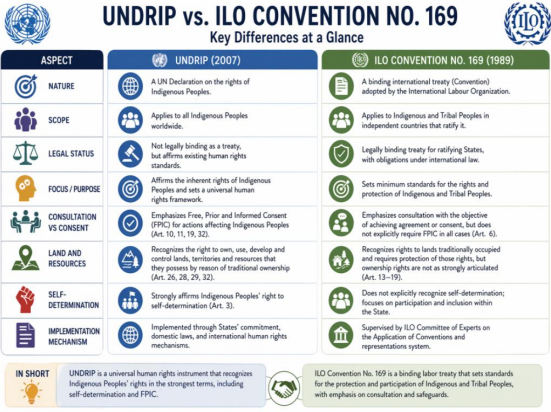
Part I: The Textual & Structural Differences Courts Must Navigate
Part II: Comparative Judicial Interpretations – Key Themes
1. On the Question of Veto Power (Consent vs. Agreement)
Under ILO 169 (Majority View): Courts almost universally reject that ILO 169 grants a veto. The duty is to consult in a culturally appropriate manner, with the goal of consent. If consultation fails in good faith, the state may proceed (subject to judicial review of the process).
Example: Chilean Supreme Court (2014 – Cascada Verde project): Ruled that failure to achieve consent under ILO 169 does not block the project. The state must only demonstrate a good-faith, culturally appropriate consultation process. Consent is aspirational.
Colombian Constitutional Court (Sentencia T-129/11): Held that ILO 169 requires a “dialogical process” but explicitly stated: “The indigenous communities do not have a right to veto… The State retains the final decision, subject to judicial control.”
Under UNDRIP (Emerging View): Some courts have interpreted UNDRIP’s explicit “consent” language as granting a qualified veto, especially for large-scale extractive projects affecting culturally vital areas.
Example: Inter-American Court of Human Rights (Kichwa Indigenous People of Sarayaku v. Ecuador, 2012): While using both instruments, the Court heavily relied on UNDRIP Art. 32 to state that the state has a duty to “obtain the FPIC of the indigenous peoples” for any major development project. Failure to obtain consent made the state internationally responsible. This is the strongest judicial move toward a veto.
Supreme Court of Canada (Tsilhqot’in Nation v. British Columbia, 2014): Referred to UNDRIP to hold that where a project would destroy the cultural or economic basis of indigenous title, “consent is required.” Without consent, the Crown cannot justify the infringement.
2. On the “Prior” Element (Timing & Free, Prior ≠ After Approval)
Both instruments require “prior” consultation, but courts have interpreted this differently.
Under ILO 169: Courts tend to accept a phased consultation as long as it occurs before the final decision to grant a concession. Consultation after environmental impact studies have begun is often upheld.
Supreme Court of Argentina (Comunidad Indígena Mapuche Curiñanco v. Provincia de Río Negro, 2018): Ruled that consultation under ILO 169 need not be before preliminary exploration work, only before the final exploitation license. This weakened the “prior” element.
Under UNDRIP: Courts interpret “prior” strictly – consultation must begin at the earliest concept stage, before any irreversible decisions.
Philippines Supreme Court (The Province of North Cotabato v. Government of the Republic of the Philippines Peace Panel, 2008): Citing UNDRIP, struck down a development agreement because consultations began only after the Memorandum of Understanding was signed. “Prior means before any form of consent is sought from any state body.”
3. On Free & Informed – The “Misinformation” Standard
Under ILO 169: Courts focus on procedural adequacy – was information translated? Were interpreters present? A lack of “informed” consent is harder to prove because the standard is consultation, not consent.
Peruvian Constitutional Court (Caso Comunidad Nativa Tres Islas, 2018): Found a violation because the state provided information in Spanish only (not the local dialect) and gave only 3 days to review a 200-page environmental study. But the remedy was a new consultation, not a project halt.
Under UNDRIP: Courts have ruled that misinformation or lack of full technical data vitiates consent entirely, because UNDRIP frames it as a substantive right, not a process.
Supreme Court of Belize (Aurora Action Group v. The Attorney General, 2017): Ruled that oil exploration without full disclosure of health and environmental risks violated FPIC under UNDRIP (though Belize has not ratified ILO 169). The court ordered a new FPIC process from scratch.
4. On Subsoil Resources (Oil, Gas, Minerals)
This is the most contentious area.
Under ILO 169, Art. 15: Explicitly states that the state retains sovereignty over subsoil resources. Indigenous peoples have rights to “participation” and “benefits” but not to veto extraction.
Chilean Supreme Court (2012 – Punta de Choros): Ruled that under ILO 169, even if an indigenous community rejects an iron mine, the state can approve it after a good-faith consultation. The right to consent “does not extend to minerals beneath the soil.”
Under UNDRIP, Art. 32: Does not distinguish between surface and subsoil. The right to “say no” to projects affecting lands/territories/resources applies regardless of ownership of the subsoil.
Supreme Court of India (Konda Reddy Samkshema Samithi v. State of Andhra Pradesh, 2020): While India has not ratified ILO 169, the court cited UNDRIP to hold that forest-dwelling communities have FPIC rights over bauxite mining, even though the state owns the minerals. This directly contradicts the ILO 169 subsoil doctrine.
Part III: A Decisive Comparative Table – Judicial Holdings
Part IV: Hybrid & Emerging Jurisprudence
Most sophisticated courts now read ILO 169 in light of UNDRIP to harmonize standards.
Inter-American Court of Human Rights (Case of the Kaliña and Lokono Peoples v. Suriname, 2015): The Court held that while Suriname is not a party to UNDRIP, UNDRIP’s FPIC standard (not ILO 169’s consultation standard) reflects evolving human rights law. It required Suriname to “obtain consent” for development on ancestral lands – effectively using UNDRIP to upgrade the ILO 169 duty.
Supreme Court of Mexico (Action of Unconstitutionality 135/2015): Ruled that Mexico’s duty under ILO 169 must be interpreted “progressively” using UNDRIP. The court created a two-tier test:
Tier 1 (ILO 169 baseline): Good-faith consultation for minor projects.
Tier 2 (UNDRIP standard): Full consent (veto) for projects involving relocation, sacred sites, or massive environmental transformation.
The Takeaway for Legal Practitioners
Final Judicial Trend: Where courts are bound by ILO 169, they interpret it as a procedural duty to consult with no veto. Where courts are free to apply UNDRIP (or use it as interpretative guidance), they are moving toward FPIC as a substantive veto right – but only for projects with severe cultural or physical impact. The most advanced courts (Inter-American, Canadian, Mexican) now apply a hybrid standard: ILO 169 for everyday matters, UNDRIP’s consent standard for existential threats to indigenous existence.
RECENT CASE STUDIES
1. Saramaka People v. Suriname (Compliance Developments, 2020)
Background: Although originally decided earlier by the Inter-American Court of Human Rights, compliance developments continued into 2020 regarding logging and mining concessions on Indigenous lands.
Issue: Whether the State must obtain FPIC or merely consult Indigenous communities.
Judgment/Development: The Court reaffirmed that large-scale projects require Free, Prior and Informed Consent (FPIC), not just consultation.
Impact:
Reinforced FPIC as a binding obligation in large-scale extractive projects.
Strengthened interpretation of UNDRIP principles over procedural consultation norms.
2. Yaqui Indigenous People v. Mexico (2021)
Background: The Yaqui community challenged the construction of a gas pipeline affecting their territory.
Issue: Whether consultation carried out by the government satisfied FPIC standards.
Judgment: Mexican courts ruled that the consultation process was deficient and failed FPIC requirements.
Impact:
Clarified that consultation must be culturally appropriate and informed.
Signaled movement toward substantive consent rather than procedural compliance.
3. Friends of the Irish Environment v. Ireland (Indirect FPIC relevance, 2022)
Background: Climate and environmental governance case with implications for community participation.
Issue: Public participation and environmental rights intersecting with Indigenous consultation norms.
Judgment: Strengthened procedural environmental rights.
Impact:
Influenced corporate due diligence frameworks.
Indirectly reinforced participatory rights aligned with FPIC principles.
4. Jair Bolsonaro Administration Indigenous Land Cases (Brazil, 2022)
Background: Policies allowing mining in Indigenous lands were challenged.
Issue: Whether economic development can override FPIC.
Judgment: Brazilian courts increasingly emphasized constitutional protection of Indigenous lands.
Impact:
Reasserted that FPIC cannot be bypassed for economic interests.
Highlighted tension between state sovereignty and Indigenous consent.
5. Greenpeace Nordic Association v. Norway (Wind Energy Case, 2023 developments)
Background: Wind farms built on Sámi reindeer herding lands.
Issue: Violation of Indigenous cultural rights and lack of proper consent.
Judgment: Norwegian courts acknowledged violations of Indigenous rights.
Impact:
Linked FPIC with cultural survival and self-determination.
Reinforced UNDRIP-based interpretation of rights.
6. Australian Federal Court – Juukan Gorge Aftermath Cases (2023)
Background: Destruction of sacred Aboriginal heritage sites by a mining company.
Issue: Whether prior approvals without proper consent meet FPIC standards.
Judgment: Courts and inquiries stressed stronger Indigenous consultation laws.
Impact:
Shift toward mandatory consent frameworks.
Triggered reforms in corporate accountability and heritage protection laws.
7. Colombian Constitutional Court – Amazon Protection Cases (2024)
Background: Indigenous communities challenged deforestation and extractive projects.
Issue: Whether environmental protection requires Indigenous consent.
Judgment: Court recognized Indigenous communities as rights-bearing entities requiring FPIC.
Impact:
Integrated FPIC with environmental and climate justice.
Strengthened biocentric legal approaches.
8. Supreme Court of Nepal FPIC Directive Case (2025)
Background: Indigenous groups challenged development projects lacking consent.
Issue: Whether FPIC is legally binding under domestic law.
Judgment:
Mandated nationwide implementation of UNDRIP and ILO 169 principles.
Recognized FPIC as a binding legal requirement.
Impact:
Major shift from consultation → consent.
Established judicial enforcement of international Indigenous rights norms.
9. Cowichan Tribes v. Canada (2025)
Background: Dispute over land rights and resource use.
Issue: Nature of Aboriginal title and whether consent is required.
Judgment:
Recognized Indigenous land rights as “prior and senior rights.”
Strengthened requirement of meaningful consent in land-use decisions.
Impact:
Elevated FPIC to a quasi-property right standard.
Increased corporate liability in resource extraction.
2026 (Emerging Trends)
10. Emerging Jurisprudence (Global Trend, 2026)
Background: Courts across jurisdictions increasingly address Indigenous claims in infrastructure, mining, and climate projects.
Key Legal Trend:
Distinction between:
Procedural consultation (ILO 169)
Substantive consent (UNDRIP)
Judicial Direction:
Greater recognition of FPIC as a right linked to self-determination
Expansion into corporate human rights due diligence obligations
Impact:
Movement toward mandatory consent regimes globally
Strengthening of Business and Human Rights (BHR) accountability frameworks

Key Differences (Comparative View)
International Norms: Jurisprudence shows divergence between UNDRIP’s strong language and ILO 169’s softer terms. Some courts (Colombia, Peru) lean on ILO 169 Art.6 (consultation) plus UNDRIP influences, while others (Canada) focus on UNDRIP as domestic law. Notably, UNDRIP is used more as persuasive context; ILO 169 is binding only where ratified (e.g. Peru, Philippines, Colombia). The OHCHR guidance underscores this distinction: “the Declaration requires states to…obtain their consent” for major projects (Art.19,32), signaling some expectation of consent under UNDRIP, but actual decisions vary.
CORPORATE ACCOUNTABILITY AND INDIGENOUS RIGHTS PROTECTION
Implications for Corporate Accountability and State Obligations
Stricter Due Diligence: Companies must now anticipate that courts may enforce rigorous consultation processes. Businesses should document good-faith engagement, negotiate in good faith, and adapt projects to indigenous concerns. Failure to secure genuine FPIC can lead to halted projects or retroactive invalidation (e.g. mining permits in PH). Firms should incorporate UNDRIP/ILO169 standards into contracts and policies, even where not legally required, to avoid liability. Corporate conduct may be scrutinized under domestic law and emerging international frameworks (e.g. OECD Guidelines).
Liability and Remedies: Courts are increasingly prepared to order remedies such as injunctions, rescission of approvals, and even damages. The Canadian case illustrates that agencies can be forced to redo their decisions; in Colombia and Norway, licenses were voided outright. This signals that companies face not only compliance risk but litigation risk if they proceed without consent. Additionally, affected communities may leverage human-rights litigation or domestic remedies (tutelas, amparos) to enforce rights.
Injunctive Relief: Judges may be more willing to grant pre-construction injunctions where consultation is found deficient. Even absent an explicit veto, a failure to meet FPIC standards can satisfy irreparable harm criteria (cultural loss). Some jurisdictions may impose stop-work orders pending proper consultation.
State Duties: States are pressured to revise regulatory regimes. Examples include Canada’s adoption of UNDRIP (UNDA, 2021) and Peru’s robust consultation law. Governments must ensure that legislation affecting indigenous lands is crafted with FPIC in mind; otherwise, laws themselves risk invalidation (Colombia C-054/23). States may also owe reparations if projects went forward without consent.
Impact Assessments: Environmental and social impact assessments increasingly incorporate FPIC. International financial institutions (IFIs) and export credit agencies may refuse funding for projects that lack documented FPIC, reflecting the legal climate.
Overall, these decisions strengthen the corporate obligation to respect indigenous rights: companies cannot claim ignorance of FPIC, and states cannot abdicate oversight. The trend suggests FPIC will be integrated into legal due diligence, akin to consultation mandates and free, prior, informed approvals in mining codes.
KEY FINDINGS
The following findings are comparative legal findings derived from the judicial analysis of leading domestic, constitutional, supreme court, and regional human rights decisions delivered between 2020 and 2026. They are based on a comparative examination of judicial interpretations of Free, Prior and Informed Consent (FPIC) under the United Nations Declaration on the Rights of Indigenous Peoples (UNDRIP) and ILO Convention No. 169, rather than on empirical surveys or statistical analysis. The findings emerge from doctrinal comparison of judicial reasoning, legal principles, and the application of FPIC in disputes concerning Indigenous peoples, land rights, natural resources, and Business and Human Rights (BHR).
Judicial Divergence between UNDRIP and ILO Convention No. 169
The comparative judicial analysis demonstrates that courts continue to adopt two distinct legal approaches to FPIC. Courts relying primarily on ILO Convention No. 169 generally interpret FPIC as a procedural obligation requiring consultation in good faith, whereas courts drawing upon UNDRIP increasingly recognize FPIC as a substantive legal right requiring the genuine consent of Indigenous peoples before approving projects with significant impacts on their lands, territories, or resources.
This comparative divergence represents the most significant legal distinction identified through the judicial analysis. Although both instruments seek to protect Indigenous peoples, courts assign different legal consequences to consultation and consent, resulting in varying standards of protection across jurisdictions.
Comparative Judicial Trend toward Recognition of Consent
The judicial decisions examined between 2020 and 2026 reveal an emerging comparative trend toward strengthening the legal requirement of consent. While consultation remains the minimum legal obligation under ILO Convention No. 169, several courts have progressively interpreted FPIC as requiring actual consent where projects involve:
relocation of Indigenous communities;
large-scale mining or extractive industries;
infrastructure affecting ancestral lands;
environmental degradation;
destruction of sacred or cultural sites; and
long-term impacts on Indigenous livelihoods.
The comparative judicial analysis therefore indicates a gradual transition from procedural consultation toward substantive consent, reflecting the growing influence of UNDRIP within domestic legal systems.
Recognition of Indigenous Self-Determination
The judicial analysis further reveals increasing judicial recognition that FPIC is closely connected with the internationally recognized right of Indigenous peoples to self-determination.
Comparatively, courts applying UNDRIP are more likely to characterize FPIC as an expression of Indigenous autonomy, governance, and collective decision-making. By contrast, courts relying primarily on ILO Convention No. 169 generally regard consultation as a procedural safeguard without necessarily recognizing Indigenous communities as final decision-makers.
According to judicial findings indicate that self-determination is increasingly influencing judicial interpretation of FPIC beyond its traditional procedural understanding.
Differences in Judicial Remedies
One of the most important comparative legal findings concerns the remedies granted by courts after identifying violations of FPIC.
The judicial analysis demonstrates that:
courts applying consultation-based standards frequently order renewed consultation or procedural corrections;
courts applying consent-based standards are increasingly willing to suspend, invalidate, or prohibit development projects where FPIC has not been obtained.
It illustrates that the legal consequences of violating FPIC differ significantly depending upon the interpretative framework adopted by the judiciary.
Expansion of Corporate Accountability
The comparative judicial analysis also indicates an important evolution in Business and Human Rights jurisprudence.
Recent judicial decisions increasingly expect corporations to:
conduct meaningful engagement with Indigenous communities;
integrate FPIC into environmental and social governance processes;
undertake comprehensive human rights due diligence; and
demonstrate genuine respect for Indigenous decision-making before commencing projects.
Although the extent of corporate obligations varies across jurisdictions, the comparative findings demonstrate a clear judicial movement toward integrating FPIC into broader corporate accountability frameworks.
Judicial Recognition of Indigenous Land Rights
Analysis reveals that courts increasingly recognize Indigenous land rights as legal rights deserving heightened judicial protection.
Several recent judgments characterize Indigenous title as a pre-existing or superior legal interest that cannot be overridden solely by state economic policies. Consequently, FPIC is no longer viewed merely as a procedural consultation requirement but as an essential legal mechanism for protecting territorial integrity, cultural identity, and Indigenous autonomy.
The comparative judicial analysis therefore confirms a growing relationship between FPIC and the protection of Indigenous land rights
Legal Uncertainty Caused by Divergent Judicial Standards
Despite progressive judicial developments, the comparative analysis identifies continuing legal uncertainty.
Judicial decisions differ considerably regarding:
the circumstances requiring consultation;
the situations requiring consent;
whether Indigenous communities possess an effective veto;
the legal consequences of inadequate consultation; and
the extent of corporate and governmental obligations.
These differences create uncertainty for Indigenous communities, governments, investors, and corporations, limiting the development of a consistent international legal standard governing FPIC.
Harmonization of International Human Rights Standards
The judicial analysis identifies an emerging comparative trend in which several constitutional and regional human rights courts interpret ILO Convention No. 169 alongside UNDRIP rather than treating the two instruments as mutually exclusive.
Instead of viewing consultation and consent as competing legal standards, courts increasingly adopt a harmonized approach whereby:
consultation serves as the minimum procedural obligation; and
consent becomes mandatory where projects seriously affect Indigenous rights.
This judicial harmonization represents one of the most significant developments identified during the comparative legal analysis.
Comparative Contribution to Business and Human Rights Jurisprudence
The judicial analysis demonstrates that FPIC is becoming a central legal principle within contemporary Business and Human Rights jurisprudence.
Across jurisdictions, courts increasingly link FPIC with:
environmental justice;
sustainable development;
responsible corporate governance;
human rights due diligence;
Indigenous participation in decision-making; and
ESG-related legal responsibilities.
The comparative findings therefore suggest that FPIC is evolving from a specialised Indigenous rights principle into a broader component of international corporate governance and human rights law.
RECOMMENDATIONS
Harmonization of International and Domestic Legal Standards
A primary recommendation is the harmonization of domestic legal frameworks with international standards on FPIC, particularly those articulated in the United Nations Declaration on the Rights of Indigenous Peoples and International Labour Organization Convention No. 169.
States should:
Explicitly incorporate FPIC into national legislation, not merely policy guidelines
Clarify when consent is mandatory (e.g., displacement, large-scale extractive projects)
Eliminate ambiguity between “consultation” and “consent”
This harmonization would reduce interpretative inconsistencies and ensure uniform application by courts and administrative authorities.
Establishment of Clear Legal Thresholds for Consent
Legal systems must develop clear doctrinal thresholds distinguishing procedural consultation from substantive consent.
This includes:
Defining high-impact activities that automatically trigger FPIC
Establishing objective criteria for determining whether consent is “free, prior, and informed”
Recognizing situations where withholding consent must halt or suspend projects
Without such clarity, FPIC risks being diluted into a procedural formality rather than a substantive right linked to self-determination.
Strengthening Judicial Interpretation and Enforcement
Courts play a critical role in shaping FPIC norms. It is recommended that judicial bodies:
Adopt a rights-based interpretation aligned with UNDRIP
Treat FPIC as a binding legal principle, particularly in cases involving land, culture, and displacement
Develop consistent jurisprudence through constitutional and human rights reasoning
Judicial training programs and guidelines should be introduced to enhance understanding of Indigenous rights and international legal standards, ensuring coherent and progressive case law development.
Integration of FPIC into Mandatory Human Rights Due Diligence
FPIC should be embedded within corporate human rights due diligence frameworks under Business and Human Rights (BHR).
States should:
Require companies to demonstrate FPIC compliance before project approval
Link FPIC obligations to licensing, environmental clearances, and financing conditions
Impose legal liability for failure to obtain consent in high-risk projects
Corporations, in turn, must move beyond minimal consultation and adopt participatory, community-led engagement models.
Institutional Mechanisms for Monitoring and Accountability
Effective implementation of FPIC requires robust institutional oversight. Governments should:
Establish independent monitoring bodies or Indigenous rights commissions
Create accessible grievance redress mechanisms for affected communities
Ensure transparency in decision-making processes
These mechanisms would enhance accountability and prevent procedural manipulation by state or corporate actors.
Capacity Building and Empowerment of Indigenous Communities
FPIC can only be meaningful if Indigenous communities are empowered to participate effectively.
Recommended measures include:
Providing legal and technical assistance to Indigenous groups
Ensuring access to independent environmental and social impact assessments
Supporting community governance structures and decision-making institutions
This ensures that consent is truly informed and voluntary, rather than influenced by power imbalances.
Recognition of FPIC as a Component of Self-Determination
States and courts should explicitly recognize FPIC as an expression of the right to self-determination, rather than a procedural requirement.
This entails:
Respecting Indigenous peoples’ authority over land, resources, and development choices
Acknowledging their right to accept, modify, or reject projects
Moving toward co-decision-making models in governance
Such recognition strengthens Indigenous autonomy and aligns legal practice with evolving international norms.
Development of Sector-Specific FPIC Guidelines
Given the complexity of industries such as mining, energy, and infrastructure, governments and international organizations should develop sector-specific FPIC guidelines.
These should:
Outline best practices for consultation and consent processes
Address industry-specific risks and impacts
Provide standardized compliance frameworks for corporations
This would enhance predictability and reduce disputes in high-risk sectors.
Promotion of Regional and International Judicial Dialogue
To address fragmentation, there should be greater cross-jurisdictional learning and judicial dialogue.
This can be achieved through:
Reference to comparative case law across regions
Engagement with regional human rights bodies
Development of international interpretative guidelines on FPIC
Such dialogue would contribute to the progressive convergence of legal standards.
Embedding FPIC in Sustainable Development Frameworks
Finally, FPIC should be integrated into broader sustainable development and ESG (Environmental, Social, Governance) frameworks.
This includes:
Linking FPIC compliance to sustainable finance and investment standards
Incorporating it into climate transition and energy projects
Recognizing Indigenous knowledge systems as essential to sustainability
This approach ensures that development is not only economically viable but also socially just and environmentally responsible.
FUTURE RESEARCH
Clarifying the Legal Threshold Between Consultation and Consent
One of the most pressing research needs is the development of a clear doctrinal framework distinguishing “consultation” from “consent.” Current judicial approaches remain inconsistent, with some courts treating FPIC as a procedural safeguard and others as a veto-like substantive right. Future studies should:
Develop comparative legal tests or indicators to determine when consent is mandatory.
Examine how different jurisdictions interpret “good faith consultation” versus “free and informed consent.”
Propose uniform legal standards that can be adopted across domestic legal systems.
Integration of FPIC into Mandatory Human Rights Due Diligence (mHRDD)
With the rise of mandatory human rights due diligence frameworks globally, future research should explore:
How FPIC can be institutionalized within corporate due diligence laws.
The role of FPIC in risk assessment, impact mitigation, and remedy mechanisms.
Comparative analysis of jurisdictions adopting mHRDD (e.g., EU frameworks) and their treatment of Indigenous rights.
Role of Regional and International Human Rights Bodies
Regional human rights courts and UN mechanisms are increasingly shaping FPIC standards. Future research should:
Examine the harmonization (or divergence) between international norms and domestic judicial decisions.
Analyze how soft-law instruments influence binding legal interpretations.
Study the role of transnational litigation and strategic advocacy in strengthening FPIC enforcement.
FPIC and Emerging Sectors (Climate, Energy Transition, and Digital Economy)
Future research must move beyond traditional extractive industries and examine FPIC in emerging contexts:
Renewable energy projects (e.g., wind, solar, hydro) and their impact on Indigenous lands.
Climate change mitigation initiatives such as carbon offset projects and REDD+.
The intersection of FPIC with digital land mapping, data governance, and AI-driven resource management.
Strengthening Remedies and Enforcement Mechanisms
A critical gap lies in the lack of effective remedies when FPIC is violated. Future research should:
Evaluate judicial and non-judicial grievance mechanisms.
Propose models for compensation, restitution, and project suspension.
Study the effectiveness of corporate accountability mechanisms, including ESG frameworks and investor pressure.
Indigenous Perspectives and Participatory Research Approaches
Much of the existing literature is doctrinal or court-centric. Future research should:
Incorporate Indigenous epistemologies and lived experiences.
Use participatory and community-based research methods.
Examine how Indigenous communities define “consent” in culturally specific contexts.
Comparative South–South Legal Analysis
Most FPIC scholarship focuses on Global North jurisdictions. Future research should:
Expand comparative studies across Asia, Africa, and Latin America.
Analyze how post-colonial legal systems adapt FPIC within plural legal frameworks.
Investigate the role of customary law and traditional governance systems in shaping consent.
CONCLUSION
The comparative analysis of judicial approaches to Free, Prior and Informed Consent (FPIC) between 2020 and 2026 reveals a clear, though uneven, transition from a procedural duty to consult toward a more substantive requirement of obtaining consent. While international frameworks such as United Nations Declaration on the Rights of Indigenous Peoples and ILO Convention No. 169 provide a strong normative foundation, their interpretation in domestic courts remains fragmented. Some jurisdictions have embraced FPIC as an enforceable right linked to self-determination, while others continue to treat it as a procedural obligation, thereby creating gaps in corporate accountability and weakening Indigenous rights protection. This inconsistency underscores the urgent need for harmonized legal standards, stronger judicial enforcement, and integration of FPIC into corporate due diligence frameworks. Ultimately, recognizing FPIC as a substantive right is essential not only for safeguarding Indigenous autonomy and land rights but also for promoting equitable, conflict-free, and sustainable development within the broader Business and Human Rights regime.