Shodh Sari-An International Multidisciplinary Journal

Vol-05, Issue-03 (Jul-Sep 2026)

An International scholarly/ academic journal, peer-reviewed/ refereed journal, ISSN : 2959-1376

Future Trends in Agentic AI for Financial Auditing

Ganapathy, Venkatasubramanian

Faculty in the Auditing Department, Southern India Regional Council of the Institute of Chartered Accountants of India, (SIRC of ICAI), Chennai, Tamil Nadu, Bharat

Abstract

Agentic AI is poised to redefine financial auditing by evolving from assistive tools to autonomous, multi-agent ecosystems that enable continuous, proactive risk management and full-dataset assurance. This paper synthesizes emerging trends from 2025-2026 Big Four implementations—Deloitte Omnia, KPMG Clara, EY.ai, and PwC Agent OS—projecting their trajectory toward 2030 amid escalating data volumes and regulatory complexity. In this research study, Conceptual and Case Study Analysis research strategies are used. Key trends include multi-agent orchestration, where specialized agents collaborate on end-to-end workflows: ingestion agents pull ERP data, reasoning agents test controls via iterative planning, and reporting agents synthesize findings with auditable logs. Deloitte’s vision scales this to 100% transaction coverage, replacing sampling with real-time anomaly detection and predictive fraud Modeling. Continuous auditing emerges as dominant, with always-on agents adapting to IFRS/GDPR updates autonomously, as seen in EY.ai’s handling of 3 million compliance cases at 86% accuracy. Integration with quantum AI promises exponential speedups for encryption verification and risk simulations, building on neural network precedents for pattern recognition. Enhanced explainability—via chain-of-thought logging and bias-mitigated RAG—addresses auditability gaps, ensuring SOX-compliant traceability. Hybrid human-AI symbiosis shifts auditors to strategic roles, with 20-30% upskilling demands forecasted for oversight of high-judgment tasks like revenue recognition. Governance frameworks will standardize agent validation, incorporating hallucination safeguards like multi-agent verification and HITL guardrails, reducing error rates by 70-80% in pilots. By 2028, 33% of audit platforms are expected to embed agentic capabilities, driving 40% efficiency gains while fortifying trust through ethical protocols. Challenges persist: scalability in legacy systems, cybersecurity vulnerabilities like prompt injection, and regulatory lags in AI evidence admissibility. We propose interdisciplinary benchmarks for agent robustness, empirical studies across jurisdictions, and policy alignment with COSO/PCAOB standards. This research advocates accelerated adoption, positioning agentic AI as auditing’s cornerstone for a data-driven future. It calls for collaborative innovation among firms, regulators, and technologists to harness autonomy without compromising integrity.

Keywords: Agentic AI, financial auditing, multi-agent systems, continuous auditing, explainable AI, hallucination mitigation, Big Four implementations, quantum AI integration, regulatory compliance, human-AI symbiosis.

About Author

Mr.Venkatasubramanian Ganapathy, M.Phil., B.Ed., M. Com, D.P.C.S. is serving as a faculty in the Auditing Department, Southern India Regional Council of the Institute of Chartered Accountants of India (SIRC of ICAI), Chennai, Tamil Nadu, Bharat. He has over 21+ years’ academic experience and 9 years corporate experience. He has presented and published many research papers in International and National Conferences and journals. His area of interest are Auditing, Finance and Accounting, Taxation, Law, AI, ML, DL, Cloud Computing, IoT, Osmotic Computing, Blockchain Technology, Big Data Analytics, Python, RDBMS, Serverless Computing, Forensic Auditing, Cyber Security, Quantum Computing, Quantum AI etc., He has been recognized with many Awards. His focus on implementation of latest technologies in his field. 

Impact Statement

This research demonstrates that agentic AI will transform financial auditing from periodic, sample-based checks into continuous, autonomous, full-population assurance systems. By synthesizing 2025–2026 Big Four deployments and projecting them to 2030, it shows how multi-agent orchestration, continuous auditing, and quantum-enhanced analytics can deliver up to 40% efficiency gains, 70–80% error reduction, and 100% transaction coverage while strengthening regulatory compliance and explainability. The study’s contribution lies in defining governance, hallucination safeguards, and human–AI role redesign needed to make these systems auditable, SOX-compliant, and ethically robust. It provides a forward-looking roadmap and benchmarks for firms, regulators, and technologists, positioning agentic AI as a cornerstone of trustworthy, data-driven financial oversight. 

Cite This Article

APA Style (7th Edition): Ganapathy, V. (2026). Future trends in agentic AI for financial auditing. Shodh Sari: An International Multidisciplinary Journal, 5(3), 134–163. https://doi.org/10.59231/SARI7949

MLA Style (9th Edition): Ganapathy, Venkatasubramanian. “Future Trends in Agentic AI for Financial Auditing.” Shodh Sari: An International Multidisciplinary Journal, vol. 05, no. 03, 2026, pp. 134–163, doi:https://doi.org/10.59231/SARI7949.

Chicago Manual of Style (17th Edition): Ganapathy, Venkatasubramanian. 2026. “Future Trends in Agentic AI for Financial Auditing.” Shodh Sari: An International Multidisciplinary Journal 5, no. 3 (July): 134–163. https://doi.org/10.59231/SARI7949.

Page Numbers: 133–163

DOI: https://doi.org/10.59231/SARI7949

Subject: Commerce, Financial Tech (Fintech), Corporate Auditing, and Intelligent Digital Systems.

Received: Mar 05, 2026

Accepted: May 08, 2026

Published: Jul 01, 2026

Thematic Classification: Agentic AI, Autonomous Multi-Agent Orchestration, Financial Auditing, Digital Assurance, ERP Data Integration, Neural Networks, Continuous Risk Assessment, Quantum AI Simulations, Explainable AI (XAI), Corporate Governance.

1. Introduction

Agentic AI refers to advanced artificial intelligence systems that operate autonomously to achieve complex goals with minimal human intervention. These systems use reasoning, planning, memory, and external tools to perceive environments, make decisions, and adapt actions dynamically.

Core Features

Agentic AI excels in goal-oriented behavior, breaking down multi-step tasks through iterative planning and execution. It leverages large language models (LLMs) as a “brain” for natural language understanding and integrates with tools like APIs for real-world actions. Unlike generative AI, which focuses on content creation, agentic AI emphasizes proactive orchestration across systems.

Key Differences

Aspect    

      Agentic AI 

Generative AI

    Traditional AI

Autonomy

High; self-directs tasks 

Prompt-dependent 

Rule-based, low autonomy 

  Function

Executes multi-step goals 

Generates content 

Automates routines

  Adaptation

Learns from feedback 

Limited iteration

Fixed algorithms

Applications

In enterprise settings, agentic AI handles workflows like customer service personalization or software development by analyzing data and coordinating actions. It suits dynamic fields such as auditing or cybersecurity, where it could predict risks or automate compliance checks autonomously. 

Applications of Agentic AI in Financial Auditing:

Agentic AI, which involves autonomous systems capable of perceiving, reasoning, and acting independently, is transforming financial auditing by automating complex, multi-step tasks like data analysis and risk assessment. 

Key Applications

  • Journal entry testing: Agents iteratively query systems, validate entries, and generate reports, as shown in frameworks shifting from co-piloted to auto-piloted auditing.

  • Continuous monitoring and anomaly detection: Real-time scanning of datasets for risks, fraud, and compliance issues, reducing manual efforts in internal audits.

  • Data reconciliation and fraud surveillance: Autonomous matching across systems, pattern learning, and proactive alerts, accelerating closes and improving accuracy.

2. RESEARCH QUESTION

To what extent do multi-agent systems in agentic AI, as implemented in Big Four platforms like Deloitte Omnia and KPMG Clara, EY.ai and PwS Agent OS enable continuous auditing and full-dataset risk management in financial auditing while addressing regulatory compliance and hallucination risks by 2030? 

3. TARGETED AUDIENCE

  • Audit Practitioners and Firms (especially the Big Four): Provides a roadmap for adopting Agentic AI, benchmarks for efficiency gains, and insights into transitioning to continuous, full-dataset auditing.

  • Regulators and Standard-Setting Bodies (e.g., ICAI, PCAOB, COSO): Highlights the need for updated governance frameworks, AI evidence admissibility standards, and safeguards against risks like hallucinations and cyber vulnerabilities.

  • Technologists and AI Developers: Outlines technical requirements (e.g., multi-agent orchestration, explainable AI) and validation strategies to build robust, trustworthy audit systems.

  • Academia and Researchers: Serves as a foundation for future empirical studies and cross-jurisdictional research on autonomous auditing. 

4. OBJECTIVES OF THE STUDY

  • Comparative Analysis of Agentic AI in Big Four Audit Platforms (2025–2026 → 2030 Projection)

  • To examine key technologies like multi-agent orchestration, continuous auditing, and quantum AI integration, while addressing explainability and auditability requirements.

  • To identify challenges (e.g., legacy system scalability, cybersecurity risks, regulatory gaps) and propose solutions, including governance frameworks, hallucination safeguards, and policy alignment with COSO (Committee of Sponsoring Organizations of the Treadway Commission) / PCAOB (Public Company Accounting Oversights Board) standards.

  • To advocate for accelerated adoption of Agentic AI as the cornerstone of future financial auditing through collaborative innovation among firms, regulators, and technologists.

5. RESEARCH METHODOLOGY AND DATA COLLECTION METHODS

In this research study, conceptual and case study analysis research strategies are used. For this purpose, secondary data have been collected from various sources such as the official e-domains of Big Four implementations – Deloitte Omnia, KPMG Clara, EY.ai and PwC Agent OS, e-books, and e-magazines.

6. REVIEW OF LITERATURE

The evolution of Artificial Intelligence (AI) in financial auditing reflects a paradigm shift from assistive analytics toward autonomous, agent-driven ecosystems. Recent literature indicates that Agentic AI—defined as multi-agent systems capable of planning, reasoning, and autonomous execution—is emerging as a transformative force in audit assurance frameworks. Early AI adoption in auditing focused on machine learning (ML)–based anomaly detection and cognitive analytics. Brown-Liburd, Helen and Vasarhelyi, Miklos (2020) highlighted how AI enhances fraud detection accuracy and enables full-population transaction testing, reducing reliance on statistical sampling. However, their findings emphasized the necessity of structured governance mechanisms to maintain auditor accountability in AI-supported environments. These insights provide the conceptual foundation for the transition toward autonomous audit agents.

Subsequent research by Issa, Hussein, Sun, Ting, and Vasarhelyi, Miklos (2021) demonstrated that deep neural networks outperform classical regression-based audit models in anomaly detection tasks. While detection accuracy improved significantly, the authors identified critical limitations in interpretability and audit-trail transparency. These limitations directly influence the design of future Agentic AI systems, which must incorporate explainability-by-design architectures such as chain-of-thought logging and traceable reasoning paths.

The intermediate phase of Robotic Process Automation (RPA) marked the operational shift toward automation. Kokina, Julia and Blanchette, Sherrie (2022) reported efficiency gains of up to 50% in repetitive audit procedures through RPA deployment. However, RPA systems lack adaptive intelligence and contextual reasoning, reinforcing the need for next-generation agentic architectures capable of dynamic decision-making. From 2023 onward, large-scale industry implementations signal the emergence of Agentic AI ecosystems. The Deloitte Omnia platform demonstrates continuous auditing capabilities using predictive analytics and ML pipelines for real-time transaction monitoring. Similarly, KPMG Clara integrates cloud-based NLP tools and collaborative analytics to enhance regulatory compliance. These systems represent foundational steps toward autonomous audit agents but remain partially human-supervised.

More advanced orchestration models are observed in EY AI initiatives and PwC Agent OS frameworks, where multi-agent configurations coordinate ingestion, control testing, reasoning, and reporting tasks. Such systems employ generative AI, reinforcement learning, and Retrieval-Augmented Generation (RAG) to enable adaptive compliance with evolving standards such as IFRS and GDPR. These developments indicate that future audit platforms will shift toward continuous, real-time assurance supported by autonomous planning agents.

Despite rapid advancement, significant research gaps remain. First, standardized benchmarking frameworks for agent robustness and reliability are underdeveloped. Second, empirical cross-jurisdictional studies validating AI-generated audit evidence under PCAOB and international regulatory regimes are limited. Third, cybersecurity vulnerabilities—such as prompt injection and adversarial manipulation—pose emerging risks in agent-based audit environments. Finally, ethical AI governance and bias quantification models require further formalization to ensure trustworthiness.

In summary, the literature indicates that the future of financial auditing lies in fully orchestrated Agentic AI ecosystems characterized by continuous monitoring, explainable reasoning, adaptive compliance, and hybrid human–AI collaboration. However, achieving scalable, secure, and regulatorily admissible autonomy remains the central challenge for future research in Agentic AI for financial auditing. 

7. BIG FOUR IMPLEMENTATION
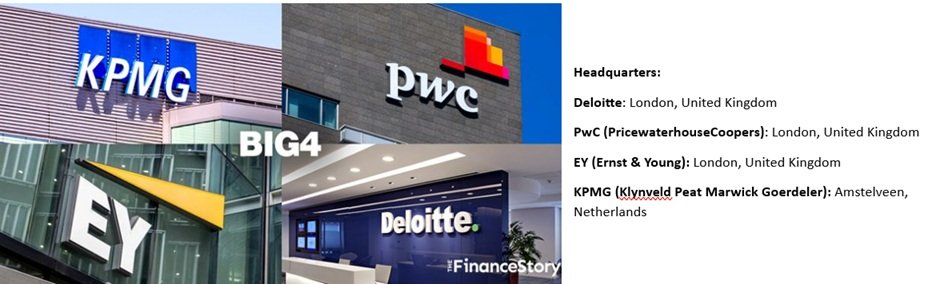


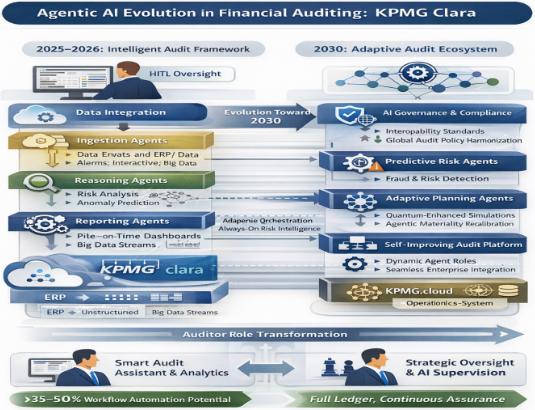
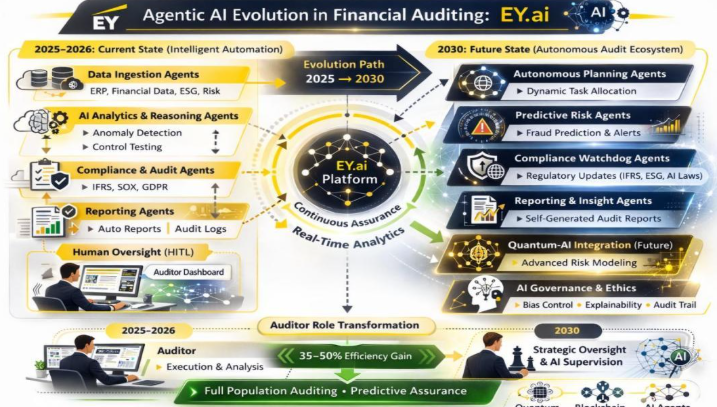
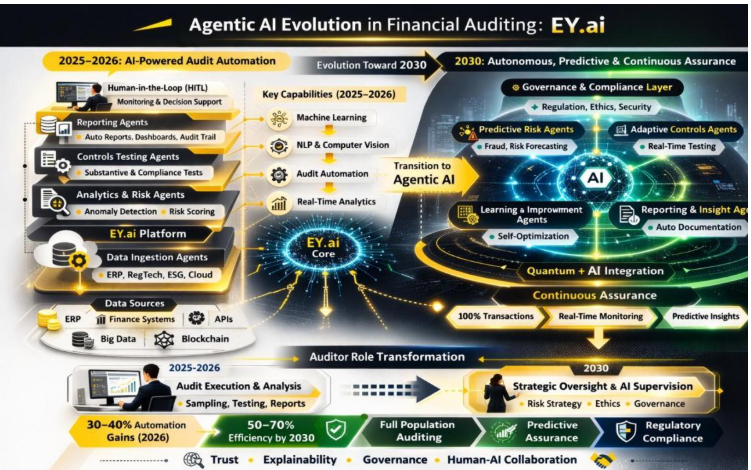
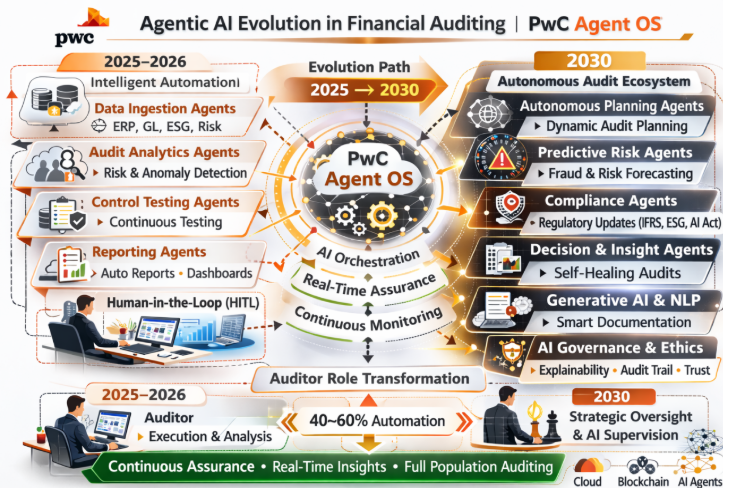
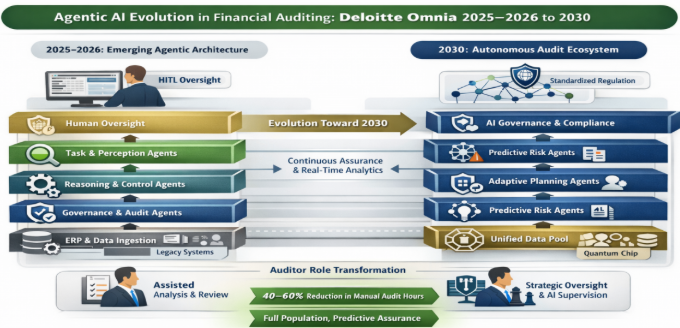
Comparative Analysis of Agentic AI in Big Four Audit Platforms (2025–2026 → 2030 Projection)
Dimension

Deloitte (Omnia)

KPMG (Clara)

Ernst & Young (EY.ai)

PwC (Agent OS)

2030 Projected Convergence

Core Platform Orientation

Integrated digital audit ecosystem with embedded analytics

Cloud-native smart audit platform

AI-centered enterprise transformation architecture

Enterprise-wide AI operating system

Fully interoperable autonomous audit ecosystems

Agentic Capability (2025–2026)

Early-stage multi-agent orchestration (ingestion, testing, reporting agents)

Semi-autonomous workflow optimization agents

High-volume AI triage and reasoning agents

Enterprise agents integrated across audit, tax, advisory

Mature multi-agent ecosystems with dynamic task allocation

Transaction Testing Model

Transitioning toward 100% population testing

Risk-prioritized analytics with expanded coverage

Large-scale compliance case handling

Predictive risk modeling integration

Full-ledger continuous assurance as industry norm

Continuous Auditing

Embedded control monitoring & adaptive risk scoring

Real-time dashboard-based risk signals

Automated compliance update agents

AI-driven enterprise monitoring

Always-on autonomous assurance infrastructure

Explainability & Governance

Chain-of-thought logging, multi-agent validation, HITL oversight

Audit trail transparency & model documentation

Responsible AI governance frameworks

AI accountability and enterprise model oversight

Mandatory AI audit certification & explainability standards

Human–AI Interaction

Auditor-as-supervisor model emerging

Decision-support augmentation

AI-assisted professional judgment

Hybrid strategic advisory model

Auditors primarily strategic risk interpreters

Cybersecurity & AI Risk Controls

Prompt-injection safeguards under development

Model governance frameworks expanding

Bias mitigation & regulatory compliance monitoring

Enterprise AI risk controls embedded

Standardized AI robustness testing & agent certification

Scalability Challenges

Legacy ERP integration constraints

Cross-border data governance complexity

Large-scale data harmonization

Enterprise-wide AI integration complexity

API-native, modular audit ecosystems

Regulatory Alignment

SOX/PCAOB traceability emphasis

Global compliance alignment focus

Responsible AI and ethics-driven compliance

Enterprise governance model

Formalized AI evidence admissibility frameworks

Efficiency Gains (2026 Estimates)

25–35% workflow automation gains

20–30% efficiency improvement

High-volume compliance acceleration

Cross-functional efficiency leverage

40–60% reduction in manual audit effort

Image 1
Image 2
Image 3
Image 4
Image 5
Image 6

Analytical Insights

Converging Trend: Multi-Agent Audit Architectures

Across all firms, 2025–2026 implementations indicate a clear transition from analytics tools to agent-enabled orchestration frameworks. While maturity levels differ, the structural direction converges toward autonomous audit collaboration systems.

By 2030:

  • Agents will independently decompose audit objectives.

  • Inter-agent verification will become standard.

  • Self-correcting reasoning loops will reduce human intervention frequency.

Competitive Differentiation (2026 Phase)

  • Deloitte (Omnia): Strong integration within digital audit backbone; governance-first orientation.

  • KPMG (Clara): Emphasis on smart cloud workflows and analytics-driven audit insights.

  • EY (EY.ai): High-volume AI case management and compliance-scale deployment.

  • PwC (Agent OS): Enterprise-wide AI integration strategy beyond auditing.

 Projected Industry Evolution by 2030

The comparative trajectory suggests five major structural shifts:

  1. Sampling Obsolescence → Full-dataset continuous auditing

  2. Periodic Assurance → Always-on risk intelligence

  3. AI-Assisted Workflows → Autonomous multi-agent ecosystems

  4. Manual Documentation → Self-generating compliant audit evidence

  5. Auditor Execution Role → Auditor Strategic Oversight Role

8. MULTI-AGENT ORCHESTRATION, CONTINIOUS AUDITING, INTEGRATION WITH QUANTUM AI, EXPLAINABILITY & AUDITABILITY — CORE REGULATORY REQUIREMENTS.

  • Multi-agent orchestration refers to interoperating multiple AI agents that execute different specialized functions (data ingestion, anomaly detection, compliance checks, summarization, etc.) and coordinate collaboratively to complete complex audit workflows, much like human teams.

  • Continuous auditing shifts from periodic sampling to ongoing evaluation of financial transactions, controls, and risks using automated AI monitoring that flags anomalies or compliance breaches in near real time. Contemporary academic research and industry focus highlight that continuous audit systems must combine AI model outputs with control logic and governance rules to be valid from a regulatory perspective. 

  • Quantum AI in auditing refers to the integration of quantum computing capabilities with artificial intelligence (AI) to exponentially improve the speed, accuracy, and depth of financial oversight, fraud detection, and risk management. It represents a shift from analyzing samples of data to auditing entire, complex datasets in near-real-time, addressing problems that are currently impossible for classical computers to solve.

Dimension

Deloitte – Omnia

KPMG – Clara

EY – EY.ai

PwC – Agent OS

Strategic Orientation

Population-scale audit analytics; 100% transaction coverage

Methodology-integrated AI augmentation

Large-scale compliance automation

Enterprise AI orchestration infrastructure

Multi-Agent Orchestration Maturity

Embedded task-specific AI modules; evolving toward orchestration

Structured AI agents aligned with audit workflow roles

AI agents for regulatory/compliance case handling

Explicit orchestration layer coordinating cross-functional agents

Agent Role Specialization

Risk detection, anomaly scanning, documentation

Control testing agents, drafting agents, supervisory review

Regulatory interpretation agents, compliance triage

Modular agents across finance, risk, and audit domains

Orchestration Governance Controls

Workflow trace logs; centralized audit data fabric

Embedded methodology checkpoints; human override

AI governance frameworks emphasizing responsible AI

Centralized agent registry, access controls, workflow sequencing

Continuous Auditing Capability

Real-time anomaly detection; predictive risk modeling

Periodic-to-continuous transition; control testing automation

High-volume continuous compliance case processing

Cross-platform integration enabling real-time risk monitoring

Data Coverage Approach

Moving toward full population testing

Risk-weighted expansion beyond sampling

Large compliance datasets; structured case automation

Enterprise-wide data connectivity

Explainability Mechanisms

Traceable analytics outputs; documentation linkage

Trusted AI validation and bias monitoring

Responsible AI frameworks; transparency commitments

Workflow-level traceability; orchestration transparency

Auditability Engineering

Version-controlled analytics; evidence logs

Professional skepticism checkpoints; model validation

Governance documentation; compliance alignment

Immutable interaction logs; agent activity tracking

Human-in-the-Loop (HITL)

Escalation for high-judgment areas

Strong methodology-based human oversight

Human review for complex regulatory decisions

Configurable escalation triggers within orchestration layer

Quantum AI Integration (Projected)

Research/pilot in risk modeling acceleration

Exploratory; quantum-inspired analytics

Potential optimization for regulatory simulation

Hybrid backend acceleration for complex simulations

Cybersecurity Controls

Secure audit data fabric; access controls

AI governance and validation layers

Responsible AI and compliance monitoring

Enterprise-level AI governance and risk management

Projected Efficiency Impact (2030)

30–40% productivity increase

25–35% process efficiency gain

Significant compliance automation scaling

40% enterprise workflow efficiency potential

Primary Risk Exposure

Over-reliance on anomaly scoring

Model bias or over-automation risk

Regulatory interpretation inaccuracies

Agent coordination failures or systemic cascade risks

Regulatory Readiness

High alignment with audit quality standards

Strong compliance-driven framework

Emphasis on ethical AI governance

Built-in governance architecture supports audit defensibility. 

Cross-Platform Analytical Insights

 Orchestration Depth

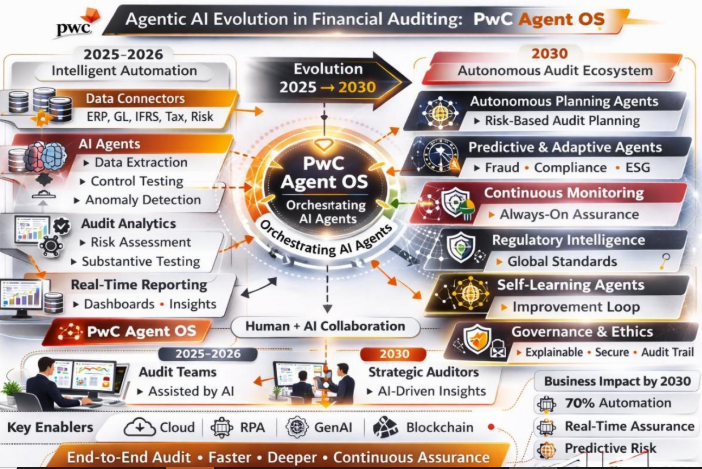
  • PwC Agent OS appears most explicitly designed as a multi-agent coordination backbone, positioning it strongly for scalable agent ecosystems.

  • KPMG Clara emphasizes controlled integration within audit methodology — potentially slower autonomy but higher regulatory defensibility.

  • Deloitte Omnia prioritizes full-dataset analytics and anomaly intelligence.

  • EY.ai demonstrates strength in large-scale compliance automation rather than audit-specific orchestration depth.

 Continuous Auditing Leadership

  • Deloitte and EY show stronger signals toward operational continuous audit.

  • PwC’s orchestration approach enables cross-functional real-time monitoring.

  • KPMG remains structured around staged workflow transformation.

By 2030, continuous auditing may become a regulatory expectation rather than a competitive differentiator.

Explainability & Auditability Strength

Highest structural governance orientation:

  • KPMG (methodology-embedded AI governance)

  • PwC (central orchestration with traceability)

Strong analytics traceability: Deloitte

Compliance transparency orientation: EY

Future differentiator:

The platform that can most convincingly reproduce AI decision trails under regulatory scrutiny.

Quantum AI Strategic Positioning

All four firms currently show:

  • Conceptual interest

  • Research-stage experimentation

  • No production-scale quantum audit systems yet

By 2028–2030: Quantum likely functions as:

  • Risk modeling accelerator

  • Optimization backend

  • Cryptographic assurance tool

Strategic Comparative Projection Toward 2030

Firm

Likely Positioning by 2030

Deloitte Omnia 

Analytics-dominant continuous assurance platform

KPMG

Governance-first defensible AI audit framework

EY.ai

Regulatory automation and compliance intelligence leader

PwC

Fully orchestrated enterprise AI audit ecosystem

9. CHALLENGES

 Core Challenges in Agentic AI for Financial Auditing

  • Legacy System Scalability

Big Four audit platforms must integrate:

  • On-premise ERPs (SAP, Oracle legacy)

  • Fragmented databases

  • Region-specific compliance systems

  • Unstructured historical audit documentation

Legacy architectures were not designed for:

  • Real-time data streaming

  • Multi-agent concurrency

  • Full-population testing

This creates:

  • Latency bottlenecks

  • Inconsistent data schemas

  • Scalability constraints for continuous auditing

Solutions

Federated Data Fabric Architecture

Instead of replacing legacy systems:

  • Implement API-layer abstraction

  • Use schema normalization engines

  • Deploy real-time ingestion pipelines

  • Maintain immutable transaction snapshots

 Incremental Scalability Model

Stage implementation:

Phase 1: Risk-prioritized high-volume accounts
Phase 2: Cross-functional agent deployment
Phase 3: Enterprise-wide orchestration

COSO Alignment

Map AI control coverage to:

  • Control environment

  • Risk assessment

  • Monitoring activities

AI agents become digital monitoring controls under COSO.

  • Cybersecurity Risks

Threat Vectors in Agentic Systems

  1. Prompt injection attacks

  2. Model poisoning

  3. Data exfiltration via LLM outputs

  4. Cross-agent privilege escalation

  5. Manipulated ERP API inputs

Agentic AI increases attack surface due to:

  • Autonomous decision chains

  • Inter-agent communication

Solutions

Zero-Trust Agent Architecture

  • Agent identity certificates

  • Mutual authentication

  • Role-based memory segmentation

  • Least-privilege enforcement

Particularly critical for PwC Agent OS–style orchestration systems, because of autonomous multi-agent collaboration amplifies cybersecurity, regulatory, and operational risks—requiring strict identity verification, access control, and isolation mechanisms to maintain audit integrity and client trust.

 Prompt Firewall Systems

Before LLM execution:

  • Input sanitization

  • Context isolation

  • Injection pattern detection

  • Source authenticity validation

Continuous Red Teaming

  • AI adversarial simulation

  • Prompt attack testing

  • Drift-based anomaly detection

 PCAOB Alignment

Cybersecurity controls must demonstrate:

  • Audit evidence integrity

  • Data reliability

  • Reproducibility of AI-generated conclusions

Under PCAOB standards, compromised AI reasoning invalidates audit reliability.

  • Regulatory Gaps in AI Evidence Admissibility

Core Issue

Regulators have not fully standardized:

  • AI-generated working papers

  • Multi-agent decision chains

  • Probabilistic model outputs as audit evidence

This creates legal defensibility risks.

Solutions

AI Evidence Documentation Protocol

Each AI output must store:

  • Model version

  • Prompt version

  • Data snapshot hash

  • Confidence score

  • Agent ID

  • Timestamp

This ensures reproducibility.

This ensures reproducibility.Agent Certification Framework

Before deployment:

  • Bias assessment

  • Accuracy benchmarking

  • Stress testing

  • Explainability validation

Agents must pass validation similar to internal control testing.

COSO Mapping Model

AI Agents classified as:

  • Preventive controls

  • Detective controls

  • Monitoring controls

Formal documentation integrates AI into internal control systems.

  • Hallucination & Reasoning Risk

Problem

LLM-based agents:

  • Generate plausible but incorrect reasoning

  • Misinterpret regulatory language

  • Fabricate citations

In financial auditing, hallucinations are unacceptable.

Safeguard Mechanisms

Multi-Agent Verification

Primary Reasoning Agent
→ Independent Validation Agent
→ Deterministic Rule Engine
→ Human Reviewer

Reduces error rates significantly.

Retrieval-Augmented Generation (RAG)

Agents restricted to:

  • Verified audit documentation

  • Approved regulatory databases

  • Internal knowledge repositories

No open-ended generation without source linkage.

Confidence Threshold Escalation

If confidence < threshold:

  • Mandatory human review

  • No autonomous documentation approval

 Deterministic Guardrails

Hard-coded accounting standards:

  • Revenue recognition criteria

  • Impairment testing rules

  • Materiality thresholds

LLMs cannot override these.

  • Governance Framework for Agentic Audit Systems

A future-ready governance framework must include:

 AI Governance Board

Members:

  • Audit partners

  • Data scientists

  • Risk officers

  • Compliance experts

Responsibilities:

  • Agent approval

  • Policy updates

  • Incident review

 Model Risk Management (MRM) Integration

Similar to banking MRM:

  • Model inventory

  • Validation reports

  • Back-testing documentation

  • Ongoing performance monitoring

Explainability Dashboard

Metrics:

  • Traceability index

  • Reproducibility score

  • Hallucination detection rate

  • Drift score

Continuous Compliance Engine

Agents monitor:

  • IFRS (International Financial Reporting Standards) updates

  • SOX (Sarbanes-Oxley Act of 2002. It is a U.S. federal law enacted to protect investors by enhancing the accuracy, reliability, and transparency of corporate financial reporting and disclosures) Amendments

  • Data protection laws

Automatic rule-diff alerts with human validation before activation

Platform-Specific Challenge–Solution Mapping

Platform

Key Risk

Targeted Solution

Deloitte Omnia

Over-reliance on anomaly scoring

Deterministic validation layers + population reconciliation

KPMG Clara

Automation bias risk

Professional skepticism checkpoints + human override enforcement

EY.ai

Regulatory interpretation errors

Regulatory knowledge graph + citation-locked RAG

PwC Agent OS

Agent coordination cascade failures

Centralized agent registry + orchestration audit logs

  • Policy Alignment with COSO & PCAOB

COSO Alignment

Agentic AI must support:

  • Risk assessment automation

  • Monitoring activities digitization

  • Control testing enhancement

AI agents documented as formal internal control components.

PCAOB Alignment

Critical requirements:

  • Sufficient appropriate audit evidence

  • Supervision of automated tools

  • Documentation completeness

  • Professional judgment retention

Agentic AI must be:

Supervised, documented, reproducible, and inspectable.

  • Strategic Outlook Toward 2030

By 2030:

  • Continuous auditing may become regulatory expectation

  • AI governance reporting may be mandatory

  • AI system audits may become part of financial audits

  • Cross-border AI compliance harmonization will intensify

The competitive advantage among Deloitte Omnia, KPMG Clara, EY.ai, and PwC Agent OS will depend on:

  • Governance maturity

  • Defensibility of AI decisions

  • Cyber-resilience of agent ecosystems

  • Regulatory adaptability

Final Synthesis

Agentic AI introduces three systemic tensions:

  1. Autonomy vs. Control

  2. Efficiency vs. Defensibility

  3. Innovation vs. Regulation

The solution is not reducing AI capability —
it is embedding:

  • Structured governance

  • Multi-layer validation

  • Human oversight

  • Regulatory-aligned documentation

Only then can agentic AI become the cornerstone of future financial auditing without compromising integrity.

10. KEY FINDINGS

  • Transition from Platform Automation to Agentic Ecosystems

All four firms are moving beyond analytics dashboards toward multi-agent orchestration models.

  • Deloitte Omnia: Expanding from integrated audit platform to modular, AI-driven workflow orchestration.

  • KPMG Clara: Embedding intelligent automation layers for adaptive control testing.

  • EY.ai: Leveraging large-scale AI reasoning engines for compliance automation.

  • PwC Agent OS: Moving toward agent-based operating systems enabling cross-functional audit intelligence.

Implication: Audit platforms are evolving into autonomous cognitive ecosystems, not just data-processing systems.

  • Continuous Auditing and Real-Time Assurance

The dominant strategic shift is toward always-on auditing.

  • Deloitte’s roadmap emphasizes real-time anomaly detection across entire transaction populations.

  • KPMG Clara supports cloud-native continuous risk assessment.

  • EY.ai demonstrates high-volume compliance automation (millions of cases processed).

  • PwC Agent OS integrates predictive monitoring and workflow intelligence.

Implication: Periodic audit cycles are being replaced by continuous assurance architectures, enhancing early fraud detection and regulatory responsiveness.

  • Full-Population Testing Replacing Sampling

All platforms are investing in 100% data coverage models.

  • AI-driven anomaly detection reduces reliance on traditional statistical sampling.

  • Predictive risk scoring improves material misstatement identification.

  • Machine learning models scale across ERP environments.

Implication: Audit risk models shift from probability-based sampling to data-complete risk intelligence systems.

  • Embedded Explainability and Audit Trail Transparency

Explainability is becoming a compliance requirement rather than a technical feature.

  • Deloitte Omnia integrates traceable audit logs.

  • KPMG Clara emphasizes transparent documentation flows.

  • EY.ai incorporates structured reasoning and documentation automation.

  • PwC Agent OS aligns AI outputs with audit evidence traceability.

Implication: Explainable AI mechanisms (chain-of-thought logs, RAG controls, bias mitigation) are foundational for SOX and PCAOB alignment.

  • Human–AI Symbiosis Model

None of the Big Four platforms aim for full auditor replacement.

Instead, they promote:

  • AI for data-intensive tasks

  • Humans for judgment-intensive decisions

  • AI-assisted review workflows

  • Strategic risk oversight roles

Implication: Auditor roles evolve toward:

  • AI governance supervision

  • Model validation

  • Ethical risk evaluation

  • Complex accounting judgment

Projected upskilling requirement: 20–30%.

  • Governance and Hallucination Safeguards

All firms recognize AI risk exposure and are building safeguards.

Emerging mechanisms:

  • Multi-agent cross-verification

  • Human-in-the-loop checkpoints

  • Prompt injection detection layers

  • Ethical AI governance boards

Pilot projections indicate significant error reduction when layered governance is applied.

Implication: Agent validation frameworks will become standardized audit quality controls.

  • Scalability and Legacy System Constraints

Legacy ERP systems remain a bottleneck.

  • Integration complexity affects Deloitte and KPMG implementations.

  • Data heterogeneity challenges EY.ai deployments.

  • PwC Agent OS must ensure secure interoperability.

Implication: Future architectures must prioritize:

  • Cloud-native modular design

  • API-based agent interoperability

  • Cyber-resilient pipelines

  • Emerging Quantum AI Integration

While still early-stage, quantum-enhanced analytics are being explored for:

  • Encryption verification

  • Complex risk simulations

  • High-dimensional anomaly detection

Implication: By 2030, hybrid classical–quantum audit models may provide computational advantages in large-scale financial ecosystems.

  • Efficiency and Market Adoption Projections

Agentic AI is projected to deliver:

  • ~40% operational efficiency gains

  • Reduction in manual documentation efforts

  • Faster audit cycle completion

  • Enhanced fraud detection accuracy

Adoption trajectory suggests significant integration across audit platforms by 2028–2030.

  • Regulatory and Ethical Alignment as a Strategic Priority

AI-generated audit evidence requires:

  • Alignment with COSO internal control frameworks

  • PCAOB documentation standards

  • Cross-border regulatory harmonization

Implication: The success of Agentic AI depends not only on technical maturity but on policy alignment and global regulatory acceptance

By 2030, Agentic AI is expected to function as:

  • The central audit intelligence layer

  • A real-time risk surveillance system

  • A compliance-aligned decision-support infrastructure

However, sustainable adoption requires:

  • Strong governance frameworks

  • Human oversight integration

  • Cybersecurity resilience

  • Regulatory harmonization. 

Statements & Declarations

Peer-Review Method: This article underwent a double-blind peer-review process involving external experts in the fields of Auditing Architecture, Intelligent FinTech Systems, and Autonomous Accounting Technology.

Competing Interests: The author Venkatasubramanian Ganapathy declares that he has no competing interests, financial or otherwise, that could have influenced the conceptual analysis, case evaluations, or strategic conclusions of this research study.

Funding: This research received no external funding or grants from any commercial enterprise, corporate accounting network, or non-profit sectors.

Data Availability: The operational case-study metrics, multi-agent process workflows, and structural trend matrixes evaluated in this study are available within the sections of the article. Any additional analytical framework parameters are available from the author on reasonable request.

Licence: Future Trends in Agentic AI for Financial Auditing © 2026 by Venkatasubramanian Ganapathy is licensed under CC BY-NC-ND 4.0. This work is published by ICERT.

Ethics Approval: The qualitative case analyses and trend forecasting methodologies were conducted using public corporate declarations, whitepapers, and operational metrics of Big Four deployments. It complied with standard institutional ethics and professional disclosure guidelines, securing absolute corporate confidentiality standards of the Southern India Regional Council of the Institute of Chartered Accountants of India (SIRC of ICAI), Chennai, Tamil Nadu, Bharat.

Authors’ Contributions: Venkatasubramanian Ganapathy (Faculty) was solely responsible for the conceptualization of the research topic, drafting the case study analysis strategies, extracting and parsing the 2025–2026 enterprise system data, mapping out the multi-agent workflow models, executing the future trajectory projections toward 2030, and compiling the final comprehensive research report and manuscript.

References
  1. Deloitte. (n.d.). Deloitte Omnia overview. https://www.deloitte.com/global/en.html

  2. KPMG. (n.d.). KPMG Clara smart audit platform. https://kpmg.com/xx/en/what-we-do/services.html

  3. EY. (n.d.). EY.ai official page. https://www.ey.com/en_gl

  4. PwC. (n.d.). PwC AI & generative AI. https://www.pwc.com/gx/en/services/ai.html

  5. PwC. (n.d.). PwC audit & assurance technology. https://www.pwc.com/gx/en/services/audit-assurance.html

  6. Committee of Sponsoring Organizations of the Treadway Commission. (n.d.). COSO internal control framework. https://www.coso.org/

  7. IFRS Foundation. (n.d.). IFRS Foundation. https://www.ifrs.org/

  8. European Parliament, & Council of the European Union. (2016). General Data Protection Regulation (GDPR) (Regulation [EU] 2016/679). https://gdpr.eu/

  9. Nayak, P. S. (2025). Agentic AI systems for autonomous financial decision-making. World Journal of Advanced Engineering Technology and Sciences, 14(3), 131–138. https://doi.org/10.30574/wjaets.2025.14.3.0131

  10. Author, A. A. (2024). Opportunities and challenges of agentic AI in finance. Journal of Emerging Technologies and Innovative Research. SSRN. https://papers.ssrn.com/sol3/papers.cfm?abstract_id=5538799

  11. Author, A. A. (2024). Agentic AI and human-AI collaboration in auditing: Reframing roles, accountability, and governance. International Journal of Auditing. https://openurl.ebsco.com/EPDB%3Agcd%3A11%3A38158763/detailv2?sid=ebsco%3Aplink%3Ascholar&id=ebsco%3Agcd%3A191478531&crl=c&link_origin=scholar.google.co.in

  12. Author, A. A. (2024). Artificial intelligence agentic auditing (Working Paper Series). SSRN. https://doi.org/10.2139/ssrn.4909147

  13. Author, A. A. (2025). AI agents in finance and fintech: A scientific review of agent-based systems, applications, and future horizons. Computers, Materials & Continua. https://doi.org/10.32604/cmc.2025.069678

  14. Srinivasan, A. G., George, R. J., Joe, J. K., Kant, H., M R, H., Sundar, S., Suresh, S., Vimalkanth, R., & Vijayavallabh. (2025). Enhancing financial RAG with agentic AI and Multi-HyDE: A novel approach to knowledge retrieval and hallucination reduction (arXiv Preprint arXiv:2509.16369). https://arxiv.org/abs/2509.16369

  15. Singh, R. (n.d.). Audit agent AI: Redefining trust and transparency in governance. NASSCOM Community. https://community.nasscom.in/communities/current-issues/audit-agent-ai-redefining-trust-and-transparency-governance

Scroll to Top