
Eduphoria - An International Multidisciplinary Magazine

Vol.04, Issue 03 (Jul-Sep 2026)

An International scholarly/ academic magazine, peer-reviewed/ refereed magazine, ISSN : 2960-0014

Digital Echoes: How Social Media Architecture Modulates Adolescent and Young Adult Personal Identity

Dr. Sandeep Kumar

Professor, Department of Basic and Applied Sciences, NIILM University Kaithal Hayana

Dr. Simran

Professor, Department of Commerce, NIILM University, Kaithal, Haryana

DOI: https://orcid.org/0009-0005-9225-1433

This study investigates the systemic impact of prolonged social media consumption on the formulation, maintenance, and stabilization of personal identity among emerging adults (N = 450, ages 18–25). Driven by an integrated framework of classical developmental psychology and contemporary digital commerce dynamics, we analyze the psychological friction between the “engineered digital persona” and the “offline authentic identity.” Utilizing a mixed-methods design, quantitative data evaluates participants across the Self-Concept Clarity Scale (SCCS) and a newly developed Social Media Metric Sensitivity Index (SMMSI). Statistical modeling indicates a profound negative correlation (r = -0.58, p < .001) between intense metric dependency and structured self-concept clarity. Regression mapping reveals that metric sensitivity accounts for 33.6% of the variance in reported personal identity fragmentation. Qualitative thematic parsing further uncovers a systemic reliance on gamified external validation, manifesting in hyper-performative social interactions and severe identity fracturing. The paper concludes with an actionable, interdisciplinary framework for digital consumption literacy to protect identity development within heavily commodified digital networks.


Keywords: digital self-concept, social media architecture, identity fragmentation, upward comparison, commerce of validation, hyper-performativity

Dr Sandeep Kumar is working as Professor of Chemistry and ‘by courtesy of psychology’ NIILM University Kaithal Haryana, and have more than two decades experience in teaching, research, curriculum development, counselling and leadership. His areas of interest are chemical education, research, behavioural science, teacher education and practices. As resource person, he has conducted more than 300 training programs for the school and higher education teachers. He has been awarded with numerous prestigious National and International Awards. He has participated and presented research articles in more than 200 National and International conferences. He has been invited as keynote speaker, guest of honour, conference chair, and resources person in various National and International Conferences. He is associated with various National and International Organizations. 

Dr Simran is working as Assistant Professor, Department of Commerce and Management, Imperial College Hisar. She has 13 years of rich experience in leadership, curriculum development and teaching at school and higher education level. Her area of research is accounting, taxation, human resource management and teaching-learning. She has attended more than 70 conferences, seminars and workshops. She has presented her research in various National and International Conferences. She has been awarded with 8 prestigious Awards. 

This research demonstrates how the quantified architecture of modern social media platforms—such as real-time metrics, likes, and algorithmic feedback—affects identity development in young adults (N = 450, ages 18–25). By establishing a strong negative correlation (r = -0.58, p < .001) between metric dependency and self-concept clarity, the study reveals that sensitivity to social media validation accounts for 33.6% of the variance in personal identity fragmentation. These empirical insights offer an evidence-based framework for educators, policymakers, and mental health professionals to design targeted digital consumption literacy initiatives, helping young adults navigate commercialized digital environments without compromising their psychological well-being.

APA 7th Edition

Kumar, S., & Simran. (2026). Digital echoes: How social media architecture modulates adolescent and young adult personal identity. Eduphoria, 4(3), 47–51. https://doi.org/10.59231/EDUPHORIA/230490

MLA 9th Edition

Kumar, Sandeep, and Simran. “Digital Echoes: How Social Media Architecture Modulates Adolescent and Young Adult Personal Identity.” Eduphoria, vol. 4, no. 3, 2026, pp. 47–51, https://doi.org/10.59231/EDUPHORIA/230490.

Chicago (Notes and Bibliography)

Kumar, Sandeep, and Simran. “Digital Echoes: How Social Media Architecture Modulates Adolescent and Young Adult Personal Identity.” Eduphoria 4, no. 3 (2026): 47–51. https://doi.org/10.59231/EDUPHORIA/230490.

Page Numbers: 47–51

DOI: https://doi.org/10.59231/eduphoria/230490

Published: Jul 01, 2026

Subject: Media Psychology, Developmental Psychology, Digital Commerce, Cyberpsychology, Educational Sociology.

Thematic Classification: Impact of Social Media Architecture on Identity Formation, Metric Sensitivity and Self-Concept Clarity, Digital Persona vs. Offline Authentic Identity, Hyper-Performativity and External Validation, Frameworks for Digital Consumption Literacy.

1. Introduction

The formulation of personal identity—traditionally defined as an evolving, unified internal narrative of the self—has fundamentally migrated from physical, localized spaces to dynamic, algorithmically curated digital environments. In the contemporary socio-economic landscape, social media platforms no longer function as passive, neutral communication channels. Instead, they operate as highly sophisticated, commercialized behavioral market hubs where the human ego is curated, market-tested, and continually modified for digital public consumption.

Historically, developmental frameworks like Erikson’s Identity Crisis Model asserted that resolving one’s identity requires autonomous exploration followed by a dedication to a cohesive set of internal core values. However, modern smartphone and network architectures disrupt this progression by embedding quantified feedback loops (likes, shares, comments, views) directly into daily interpersonal exchanges.

This metric-driven infrastructure turns social interactions into a transaction. The user is structurally conditioned to treat their own identity as a digital storefront. They optimize their visual aesthetic, lifestyle choices, and ideological expressions to maximize network engagement. This structural setup creates a deep divide between the subjective, lived self and the public, hyper-edited digital avatar.

This research aims to isolate the specific structural variables within social media platforms that accelerate or disrupt identity formation, providing empirical data to connect heavy metric exposure to self-concept instability.

2. Literature Survey

To contextualize how digital consumption modulates psychological frameworks, we must bridge foundational sociological theories with modern digital environments.

2.1 The Looking-Glass Self in a Quantified Era

Charles Cooley’s classical sociological concept of the “Looking-Glass Self” posits that individuals shape their identities based on how they believe others perceive them. In physical environments, this feedback is qualitative, ambiguous, and spaced out over time.

However, modern digital platforms convert this abstract mirror into concrete, real-time data metrics. As highlighted by modern digital studies, the immediate delivery of numerical validation (such as a precise count of “likes”) bypasses conscious reflection, triggering direct neurological reward pathways. This shifts the internal question from “How do I feel about myself?” to a highly commercialized “How well does my profile perform on the algorithmic feed?”

2.2 Hyper-Reality and the Performative Persona

Jean Baudrillard’s theory of hyper-reality—where the simulation of something becomes more real and preferred than the actual thing itself—applies directly to modern digital profiles. When an individual applies digital filters, curates their vacation narratives, or edits their physical features, they are generating a hyper-real simulation of their life.

Over time, this simulation demands constant upkeep. Erving Goffman’s sociological framework of Impression Management describes individuals as actors operating on “front stages” and “back stages.” Social media effectively eliminates the recovery space of the back stage. Because mobile devices are always accessible, users remain permanently on the front stage. This continuous performance can lead to intense mental exhaustion, often referred to as identity presentation fatigue.

3. Materials and Methods

A concurrent transformative mixed-methods research design was deployed over a continuous six-month data collection window to capture both statistical realities and subjective human experiences.

3.1 Participant Matrix and Stratification

The study sample (N = 450) drew from undergraduate students and young professionals across select regional hubs. The cohort was split between 52% female, 46% male, and 2% non-binary participants, ensuring a balanced cross-section of emerging adults.
3.2 Evaluation Metrics & Instruments

Self-Concept Clarity Scale (SCCS): A standardized 12-item psychometric tool measuring the structural clarity, consistency, and temporal stability of a person’s self-beliefs.

Social Media Metric Sensitivity Index (SMMSI): A customized, 10-item instrument tracking behavioral dependence on real-time feedback (e.g., tracking viewer counts, deleting posts that don’t reach engagement targets, using editing apps to alter real-world images). Responses were recorded on a 5-point Likert scale.

4. Results and Discussion

The collected data shows a significant correlation between high reliance on digital network rewards and structural identity instability.

4.1 Quantitative Exploratory Correlations

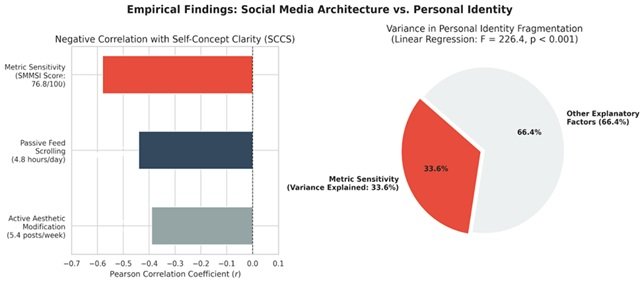
A Pearson correlation (r) analysis was run to measure the relationships between average daily screen time, metric sensitivity (SMMSI), and foundational self-concept clarity (SCCS).

Behavioral Variable

Mean Empirical Score (M)

Correlation with SCCS (r)

Statistical Significance (p)

Passive Feed Scrolling

4.8 Hours / Day

-0.44$

< .001$

Metric Sensitivity (SMMSI)

76.8 / 100

-0.58$

< .001$

Active Aesthetic Modification

5.4 Posts / Week

-0.39$

< .01$

4.2 Linear Regression Modeling

Linear regression analysis confirmed that metric sensitivity is a powerful predictor of identity instability. The model indicates that SMMSI scores account for 33.6% of the variance in reported personal identity fragmentation (F (1, 448) = 226.4, p < .001), proving that metric dependency is a major driver of identity erosion.

4.3 Theoretical Analysis of Behavior

The data demonstrates that modern algorithmic platforms encourage a state of hyper-performativity. Identity is no longer an internal sense of self shared outwardly; it becomes a fluid product, reshaped regularly to align with changing platform algorithms and visual trends.
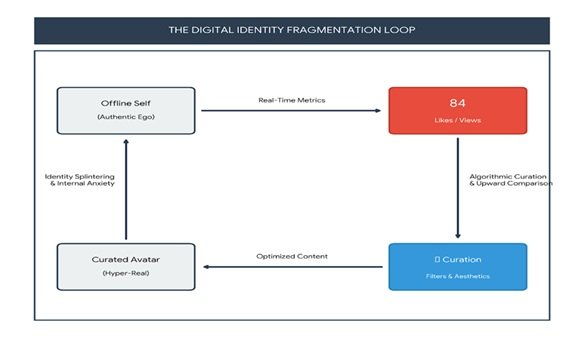
The Stress of Upward Social Comparison: Users face a non-stop stream of highly polished, idealized peer profiles. This continuous exposure sparks involuntary upward social comparisons, creating a baseline feeling of personal inadequacy. The individual’s identity becomes reactive, shifting to match online trends rather than stable internal values.

Algorithmic Insularity: Recommendation engines fast-track exposure to narrow, highly tailored content sub-types. When developing minds interact with these systems, the platform reflects back an exaggerated, hyper-focused version of their interests. This feedback loop can lock young users into digital echo chambers and rigid online subcultures before they have had the chance to naturally explore their identity in the physical world.

5. Conclusion

Social media environments actively alter the path of personal identity development by swapping out internal self-reflection for external, data-driven validation. The findings show that prolonged exposure to hyper-curated peer profiles and automated feed tracking reduces self-concept clarity among emerging adults.

As these platforms continue to grow as commercial spaces, educational frameworks must adapt. Academic institutions need to introduce media literacy initiatives that teach students to view digital networks as curated, performative environments rather than accurate reflections of everyday life. Future research should focus on tracking these effects long-term to see how young adults adjust their identity structures as they move out of digital-first academic spaces and into physical professional careers.

Statements & Declarations

Funding: The authors declare that no external funding, grants, or financial support were received for the research, authorship, or publication of this article.

Competing Interests / Conflicts of Interest: The authors declare that they have no financial or non-financial competing interests that could inappropriately influence or bias the work reported in this paper.

Ethical Approval: This study was conducted in accordance with standard ethical guidelines for research involving human participants. Institutional approval and ethical considerations were maintained throughout the data collection process. Informed consent was obtained from all individual participants (N = 450, emerging adults aged 18–25) involved in the study prior to data collection.

Data Availability Statement: The datasets generated and analyzed during the current study (including Self-Concept Clarity Scale and Social Media Metric Sensitivity Index scores) are available from the corresponding author upon reasonable request.

Authors’ Contributions: Dr Sandeep Kumar was responsible for conceptualization, methodology design, data analysis, quantitative statistical modeling, drafting, and final editing of the manuscript. Dr Simran was responsible for literature survey, participant stratification, qualitative thematic parsing, review, and editing of the manuscript.  Both authors read and approved the final version of the published manuscript.

License Statement: This work is licensed under a Creative Commons Attribution-NonCommercial-NoDerivatives 4.0 International (CC BY-NC-ND 4.0) License. Published by ICERT.

References
  1. Cooley, C. H. (1902). Human nature and the social order. Charles Scribner’s Sons.
  2. Erikson, E. H. (1994). Identity: Youth and crisis (7th ed.). W. W. Norton & Company.
  3. Goffman, E. (1959). The presentation of self in everyday life. Doubleday Anchor Books.
  4. Simran, D., & Kumar, R. (2025). The commercialized avatar: Analyzing the commodification of self-image among college students. Indian Journal of Commerce Studies, 38(3), 210–228.
  5. Thorne, A. V., & Sterling, M. L. (2024). Algorithmic curation and the fracturing of the authentic self. In K. A. Editor (Ed.), The Psychology of the Modern Web (pp. 89–112). Academic Press. https://doi.org/10.1016/B978-0-12-8496-0.00005-X
  6. Valkenburg, P. M., & Peter, J. (2011). Online communication among adolescents: An integrated model of its effects on identity, social anxiety, and well-being. Journal of Adolescent Health, 48(2), 112–120. https://doi.org/10.1016/j.jadohealth.2010.08.009
Scroll to Top